


The Complete Guide to Social Media Advertising: Platform Selection, Budget Allocation, and ROI Optimization
Social media advertising represents one of the largest and most dynamic segments of digital marketing spend; yet, many CMOs struggle to answer basic questions about their programs confidently. Which platforms deserve the most significant budget allocation? What performance benchmarks should campaigns target? How do you measure accurate return when customers interact with multiple touchpoints before converting?
These questions grow more pressing as costs increase across platforms. The era of cheap social media impressions has come to an end. CPMs continue to climb year over year, platform algorithms become more sophisticated, and competition for attention intensifies. Success now requires strategic precision rather than scale alone.
This guide provides the benchmarks, frameworks, and strategic perspective CMOs need to build high-performing social advertising programs. Drawing from current research across major platforms, industry verticals, and campaign types, the following sections establish clear reference points for evaluating performance, allocating budgets, and optimizing toward business outcomes. Whether refining an existing program or building capabilities from scratch, these insights translate directly into more effective advertising investments.
The Current State of Social Media Advertising: 2026 Benchmarks and Trends

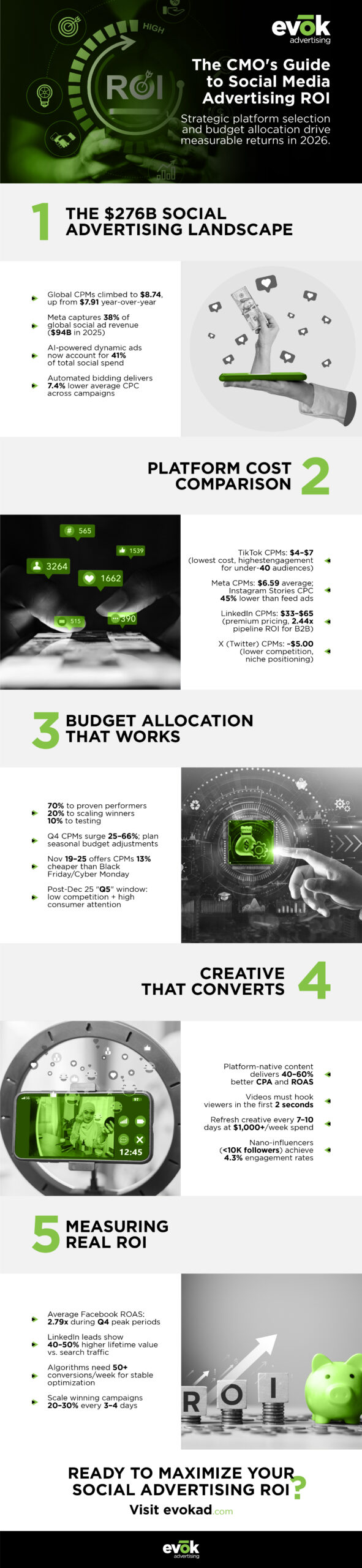
Social media advertising has matured into a $276 billion+ global industry, yet the rules of engagement continue to shift beneath marketers’ feet. What worked reliably in 2024 now demands recalibration. Rising costs, algorithmic changes, and evolving user behaviors have created a landscape where strategic precision matters more than ever.
The numbers tell a compelling story. Meta continues to dominate, capturing approximately 38% of global social ad revenue and generating $94 billion in 2025 alone. But dominance doesn’t mean stagnation. The average global CPM climbed to $8.74, up from $7.91 the previous year, reflecting intensified competition for user attention across platforms. For CMOs managing tighter budgets, this cost creep necessitates a more intelligent allocation rather than simply increasing spending.
Platform dynamics have also shifted considerably. TikTok users now spend an average of 95 minutes daily on the app, making it one of the most lucrative environments for video advertising. Instagram Stories ads yield 29% higher click-through rates than standard feed placements, prompting brands to adopt ephemeral content formats. LinkedIn, meanwhile, has solidified its position as the go-to platform for B2B advertising, with 97% of B2B marketers incorporating it into their marketing strategies.
According to the Gupta Media Social CPM Tracker, Meta’s October 2025 CPM averaged $6.59, with cost-per-link-click at $0.68. TikTok maintained its position as the cost leader, with CPMs ranging from $4 to $7, while LinkedIn commanded premium rates, with CPMs between $33 and $65 for typical B2B targeting. These platform-specific cost structures fundamentally shape where advertising dollars generate the most substantial returns.
The shift toward AI-powered optimization represents another defining trend. Brands using automated bidding tools experienced a 7.4% decrease in average CPC across campaigns. Dynamic ads driven by AI personalization now account for 41% of total social ad spend, signaling that machine learning has transitioned from experimental to essential. CMOs who resist automation risk paying more for diminishing results.
Privacy changes continue to reshape targeting capabilities as well. The post-iOS 14 landscape forced advertisers to adapt, and those adaptations are now table stakes. First-party data strategies, conversion API implementations, and creative testing have become non-negotiable components of effective social advertising programs.
For marketing leaders navigating 2026, success requires understanding these shifts and building strategies that account for rising costs, platform-specific opportunities, and the increasing role of automation in campaign optimization.
Understanding Social Media Advertising ROI and Performance Metrics

Impressions and engagement rates make for attractive dashboard screenshots, but they rarely answer the question CFOs actually ask: what did we get for that spend? Effective social media advertising measurement requires moving beyond vanity metrics to indicators that directly connect to business outcomes.
Return on ad spend (ROAS) serves as the north star metric for most performance-focused campaigns. This calculation divides revenue generated by advertising cost, expressed as a ratio or multiplier. A ROAS of 2.79 means every dollar spent returns $2.79 in revenue. According to Triple Whale’s analysis of 11,000+ ad accounts, the average ROAS across all industries on Facebook increased to 2.79 during peak Q4 periods, representing an 11.60% improvement from the prior month. Understanding where your campaigns fall relative to these benchmarks helps determine whether your optimization efforts are practical.
Cost metrics tell the efficiency story. Cost per click (CPC) measures what you pay for each visitor, while cost per acquisition (CPA) captures the actual expense of converting that visitor into a customer or lead. The gap between these two numbers reveals the efficiency of the funnel. A low CPC paired with high CPA signals landing page or offer problems rather than advertising issues. WordStream’s 2025 Facebook Ads Benchmarks found that while CPCs increased modestly (2.13% for Lead Ads), cost per lead jumped 20%, indicating that post-click conversion optimization deserves as much attention as ad creative.
For B2B organizations, pipeline metrics matter more than surface-level engagement. HockeyStack’s analysis of $28 million in LinkedIn ad spend revealed that Q1 delivered a 2.44x pipeline ROI, indicating that every dollar invested generated $2.44 in qualified pipeline value. This approach connects advertising directly to sales outcomes rather than stopping at lead counts.
Click-through rate (CTR) remains a valuable diagnostic tool rather than a success metric. A strong CTR confirms that creative and targeting resonate with the audience, but high CTRs that fail to convert simply drain budget faster.
The most sophisticated measurement approaches incorporate multi-touch attribution, recognizing that customers rarely convert after a single ad exposure. Social advertising often initiates awareness that converts through other channels, making last-click attribution a misleading measure. Building measurement frameworks that account for these assisted conversions provides a more accurate picture of social advertising’s actual contribution.
Comparing Major Platforms: Facebook, Instagram, TikTok, LinkedIn, and X

Each social platform offers distinct advantages, audience compositions, and cost structures. Understanding these differences enables CMOs to allocate budgets strategically, rather than spreading their spend thin across every available channel.
Meta (Facebook and Instagram): The Established Workhorses
Meta’s advertising ecosystem remains the most mature and versatile option for most businesses. Facebook reaches the broadest demographic range, with particularly strong penetration among users 18-44. Instagram skews younger and performs exceptionally well for visually driven brands in the retail, fashion, beauty, and lifestyle categories.
Cost efficiency on Meta platforms remains competitive despite increased competition. Brafton’s 2025 Social Advertising Benchmarks report indicates an average Facebook CPC of $1.86 across industries, although this varies significantly by vertical. Finance and insurance advertisers pay the highest rates at $3.77 per click, while apparel brands enjoy the lowest at just $0.45. Instagram feed ads command higher CPCs around $3.35, though Stories placements offer better value at $1.83.
The targeting capabilities within Meta’s ecosystem remain unmatched in depth and flexibility. Custom audiences, lookalike modeling, and detailed interest targeting allow precise audience definition. Conversion tracking through the Meta Pixel and Conversions API provides robust measurement when properly implemented.
LinkedIn: Premium B2B Targeting at Premium Prices
LinkedIn occupies a unique position as the only platform purpose-built for professional audiences. For B2B marketers targeting decision-makers by job title, company size, industry, or seniority, no other platform offers comparable precision.
This precision comes at a cost. The average CPC ranges from $2 to $3, with some B2B verticals exceeding this range. CPMs typically range from $33 to $65 for standard B2B targeting. These rates significantly outpace those of other platforms, yet often deliver superior lead quality that justifies the premium.
LinkedIn’s strength lies in considered purchases with longer sales cycles. Software companies, professional services firms, and enterprise solutions providers frequently find that LinkedIn’s higher costs produce better pipeline outcomes than cheaper clicks elsewhere. The platform’s Lead Gen Forms reduce friction by pre-populating user information, resulting in completion rates of around 13%.
TikTok: Lower Costs, Higher Engagement, Younger Audiences
TikTok has evolved from an experimental channel to an essential platform for brands targeting consumers under 40. The platform’s algorithm excels at content discovery, meaning strong creative can achieve significant reach even with modest budgets.
Cost efficiency remains TikTok’s compelling advantage. Current benchmark data indicate average CPMs ranging from $3 to $15, with most campaigns falling within the $4-$7 range. CPCs typically run $0.20 to $2.00, depending on targeting and creative quality. These rates make TikTok attractive for awareness campaigns and top-of-funnel audience building.
The platform demands creative adaptation. Polished brand advertisements often underperform compared to authentic, creator-style content. Native-feeling content with strong hooks in the first two seconds outperforms traditional advertising approaches significantly.
X (Formerly Twitter): Niche Positioning in a Changed Landscape
X offers lower costs than most competitors, with average CPMs around $5.00 and CPCs below Facebook averages. The platform’s real-time nature makes it valuable for newsjacking, event marketing, and reaching audiences engaged with current events.
However, advertiser exodus following the platform’s 2023 ownership transition has reduced competition while also raising brand safety concerns for some organizations. The platform works best for brands that are comfortable with their current positioning and those targeting audiences active in the tech, media, finance, or political discourse sectors.
How to Select the Right Social Media Platforms for Your Business Goals

Platform selection should be driven by business objectives rather than platform popularity. A methodical approach aligns campaign goals with platform strengths, ensuring that budget is allocated to channels most likely to deliver the desired outcomes.
Awareness campaigns prioritize reach and frequency at efficient costs. TikTok and Facebook excel here, offering broad audiences and competitive CPMs. Brands launching new products or entering new markets benefit from these platforms’ ability to generate exposure quickly without incurring high costs.
Lead generation demands different considerations. B2B companies targeting specific professional audiences find LinkedIn’s premium pricing justified by the quality of leads. Consumer brands often achieve strong lead generation results on Facebook and Instagram, where form-based lead ads and landing page traffic campaigns both perform reliably.
Direct response and e-commerce campaigns require platforms with proven purchase intent. Meta’s shopping integrations and robust pixel tracking make it the default choice for most online retailers. TikTok Shop has emerged as a legitimate channel for brands selling products that resonate with younger consumers, as TikTok users are 1.5 times more likely to purchase products discovered on the platform immediately.
Audience demographics should inform platform prioritization. Brands targeting professionals over 35 may find limited returns on TikTok despite its cost advantages. Companies selling to Gen Z may struggle to generate meaningful engagement on Facebook, despite its sophisticated targeting capabilities. Matching platform user bases to customer profiles prevents wasted spend on misaligned audiences.
Consider the travel and hospitality sector as an example. Evok’s work with Orlando Marriott Lake Mary demonstrated how strategic social media campaigns drive measurable results when platform selection aligns with target traveler demographics and campaign objectives.
Budget Allocation Strategies for Multi-Platform Social Media Advertising

Effective budget allocation balances proven performers against promising experiments. The 70/20/10 framework provides a starting structure: 70% of the budget is allocated to established, high-performing channels and campaigns, 20% supports scaling recent winners, and 10% funds the testing of new platforms, audiences, or creative approaches.
Platform minimums constrain minimal budgets. TikTok requires a minimum of $500 per campaign, with a daily minimum of $20 per ad group. LinkedIn’s $10 daily minimum may seem modest until factoring in the higher CPCs that require larger budgets for effective data collection. Facebook offers the most flexibility, allowing campaigns to launch with smaller daily budgets while still achieving delivery.
Seasonality has a significant impact on costs and should be considered when planning budgets. According to Gupta Media’s State of Social Media CPM Report, which analyzes tens of billions of ad impressions across industries, CPMs can surge up to 66% during the Q4 holiday shopping season, with peak periods like Black Friday and Cyber Monday seeing rates as much as 138% higher than annual averages. Savvy advertisers either increase Q4 budgets to maintain reach or shift spending to lower-competition periods when efficiency improves.
Gupta Media’s seasonal analysis identifies strategic windows that savvy advertisers exploit. The period from November 19 to 25 offers CPMs approximately 13% cheaper than Black Friday/Cyber Monday, while consumer spending is already heating up. The post-December 25 “Q5” period features low competition and close attention, creating a high-ROI window for brands willing to stay active while their competitors take a break.
Geographic considerations also shape allocation decisions. Campaigns targeting Latin America and Southeast Asia typically yield lower CPMs and CPCs compared to those in North American and European markets. Brands with flexibility in geographic targeting can stretch their budgets further by incorporating these cost-advantaged regions, where relevant to their business objectives.
Testing budgets require protection from performance pressure. New platforms, audiences, and creative concepts need sufficient investment to generate statistically meaningful data before judgment. Cutting tests too early based on limited data prevents the discovery of potentially valuable opportunities.
Creating Ad Creative and Targeting That Maximizes Conversion Rates
Creative quality has a direct impact on both performance and cost efficiency. Platforms reward engaging content with lower costs and broader reach, making creative development a strategic investment rather than a mere production expense.
Platform-native creative outperforms repurposed assets consistently. Content created specifically for TikTok, following the platform’s aesthetic conventions, delivers 40-60% better CPA and ROAS than polished brand advertisements simply reformatted for the platform. Each platform has distinct creative expectations, and meeting those expectations improves performance.
The first moments of video content determine success or failure. TikTok’s internal data shows that videos capturing attention within the first two seconds dramatically outperform content that builds up over time. This “hook” principle applies across platforms, though optimal pacing varies. Instagram users tolerate slightly longer introductions, while Facebook audiences fall somewhere between.
Creative fatigue erodes performance over time, requiring regular refreshes. Best practice suggests updating hooks and visual elements every 7-10 days once campaigns reach a weekly spend of $1,000. Smaller budgets can extend creative lifecycles, but all campaigns eventually suffer when audiences are repeatedly exposed to duplicate content.
Targeting strategy balances precision against scale. Extremely narrow audiences drive up costs by limiting competition within the ad auction. LinkedIn advertising experts recommend avoiding audiences with fewer than 50,000 members, as this creates artificial scarcity and inflates CPCs. Starting broader allows algorithms to identify responsive segments, which can then inform more targeted approaches in subsequent campaigns.
Influencer and creator partnerships offer an alternative path to authentic content. Nano-influencers with under 10,000 followers deliver average engagement rates of 4.3%, significantly outperforming mega-influencers. Partnering with relevant creators generates authentic content that resonates with audiences while reducing internal production demands.
Measuring and Optimizing Cross-Platform Social Media Campaign Performance

Measurement frameworks must span platforms while accounting for each channel’s unique contribution to business outcomes. Siloed platform reporting tells incomplete stories, often undervaluing channels that drive awareness converted elsewhere.
Attribution modeling choices significantly impact how credit is distributed across channels. Last-click attribution systematically undervalues social advertising, which frequently initiates customer journeys that conclude through search or direct traffic. Multi-touch attribution models offer a fairer distribution, but they require more sophisticated implementation. LinkedIn traffic converts 20-30% lower than Google search traffic in immediate response campaigns; yet, those LinkedIn-sourced leads often show a 40-50% higher lifetime value, making attribution window selection crucial for accurate assessment.
Learning phases require patience before optimization. Platform algorithms need sufficient conversion data to optimize effectively, typically requiring 50 conversions per week for stable performance. Optimizing campaigns too aggressively during this learning period can prevent algorithms from identifying optimal audiences, ultimately costing more than allowing the initial learning investment.
Automated bidding strategies have proven their value across platforms. Starting with the lowest-cost or maximizing conversions bidding allows data collection without manual bid management. Once baseline performance is established, shifting to cost cap or target CPA bidding maintains efficiency while giving algorithms clear optimization targets.
A regular optimization cadence strikes a balance between responsiveness and overreaction. Weekly performance reviews identify concerning trends, while daily optimizations risk responding to normal statistical variation. Campaigns consistently exceeding benchmarks can scale budgets by 20-30% every 3-4 days without significant performance degradation, according to Meta advertising best practices.
Cross-platform budget reallocation based on performance data maximizes overall program efficiency. Funds shift from underperforming platforms toward channels that demonstrate more substantial returns, while maintaining testing budgets on secondary platforms prevents over-concentration on a single channel.
Industry-Specific Benchmarks: What to Expect by Vertical

Platform-wide averages obscure significant vertical variation. A CPC that signals strong performance for a financial services company would indicate serious problems for an apparel retailer. Understanding industry-specific benchmarks enables accurate performance assessment.
Financial services and insurance advertisers face the highest costs across platforms. WordStream’s industry analysis reports average Facebook CPCs of $3.77 for this sector, roughly double the all-industry average. These costs reflect intense competition for high-value customers with substantial lifetime value. LinkedIn costs prove even higher for B2B financial services, with CPLs often exceeding $200 in North American markets.
Healthcare and pharmaceutical advertisers navigate unique constraints beyond cost. Compliance requirements limit targeting options and creative approaches, often reducing campaign efficiency compared to less regulated industries. Conversion tracking proves challenging when ultimate conversions occur offline in clinical settings. Despite these obstacles, digital patient acquisition strategies continue to grow as healthcare organizations recognize the advantages of social advertising’s reach.
Retail and e-commerce advertisers generally enjoy more favorable cost structures. Apparel brands see average Facebook CPCs around $0.45, with travel and hospitality also benefiting from below-average costs under $1.00. These verticals benefit from visually engaging products that perform well in image and video formats across platforms.
Restaurant and food service marketing operates on thin margins where efficiency matters tremendously. Local targeting capabilities on Facebook and Instagram enable geographic precision, minimizing wasted spend on unreachable consumers. TikTok has emerged as particularly effective for restaurants, with food content generating strong organic engagement that paid campaigns can amplify.
B2B technology and software companies represent a distinct category with unique dynamics. Extremely high Google CPMs ($383.24) reflect intense competition and high customer values, prompting many B2B tech advertisers to turn to LinkedIn despite its premium pricing. The math often favors paying more for precisely targeted decision-makers over paying less for broadly targeted audiences requiring extensive qualification.
Common Budget Mistakes and How to Avoid Them

Even sophisticated marketing organizations make preventable errors in social advertising budget management. Recognizing these patterns allows CMOs to sidestep pitfalls that drain budget without delivering proportionate returns.
Spreading the budget too thin across platforms prevents achieving meaningful results anywhere. Each platform requires a minimum investment level to gather data, complete learning phases, and optimize for efficiency. A $5,000 monthly budget divided across five platforms leaves each channel underfunded. Concentrating on two or three platforms aligned with business objectives yields better outcomes than maintaining a superficial presence everywhere.
Insufficient testing investment starves programs of innovation. When every dollar must immediately justify itself, organizations stop experimenting with new audiences, creative approaches, or platforms. This short-term focus gradually degrades performance as existing tactics fatigue. Protecting 10% of the budget for pure testing, insulated from immediate ROI pressure, maintains the long-term health of the program.
Ignoring creative fatigue can lead to gradual performance decay that compounds over time. Campaigns showing declining CTRs and increasing CPCs often suffer from simple audience exhaustion with unchanged creative. Establishing refresh calendars and monitoring frequency metrics prevents this slow erosion.
Over-optimizing based on limited data leads to false conclusions. Statistical significance requires sufficient sample sizes, yet many advertisers make significant decisions based on hundreds of impressions rather than thousands. Platforms compound this problem by surfacing data that lacks reliability. Waiting for meaningful data before concluding campaigns have failed prevents abandoning potentially successful approaches prematurely.
Failing to account for seasonality causes predictable budget crunches and missed opportunities. Q4 costs increase substantially across all platforms, yet many budgets remain flat throughout the year. Building seasonal fluctuations into annual planning allows for maintaining share of voice during competitive periods and exploiting efficiency during slower months.
Neglecting post-click experience wastes advertising investment regardless of campaign quality. The best-performing ads cannot overcome landing pages that load slowly, present unclear offers, or create friction in conversion processes. Auditing and optimizing the entire funnel, not just advertisements, maximizes return on advertising spend.
Building a Data-Driven Social Advertising Strategy for Long-Term Growth

Sustainable social advertising success requires systematic approaches that compound over time, rather than relying on one-off campaign wins. Building programs that learn and improve with each campaign creates durable competitive advantages.
Centralized measurement across platforms enables proper cross-channel optimization. When each platform reports only its own contribution, understanding the complete customer journey becomes impossible. Implementing consistent tracking, unified attribution modeling, and holistic reporting surfaces insights that platform-specific views obscure.
Documentation creates institutional knowledge that persists even after personnel changes. Recording what worked, what failed, and why enables organizational learning. Without this documentation, new team members repeat the mistakes of predecessors, while successful approaches get forgotten.
Testing frameworks should be systematic rather than sporadic. Define clear hypotheses, establish success criteria before launching tests, and document learnings regardless of outcome. Failed tests that generate insights provide value. Random experimentation without structure generates activity without learning.
Competitive monitoring provides context for performance assessment. Understanding what competitors invest in social advertising, which messages they emphasize, and how their strategies evolve informs strategic planning. Tools like Meta’s Ad Library offer transparency into competitor creative approaches.
The complexity of managing multi-platform social advertising programs across numerous campaigns, creative variations, audience segments, and optimization decisions often exceeds internal capacity. Organizations that recognize when expert partnership accelerates results avoid the hidden costs of undermanaged programs. Agencies specializing in social media marketing bring cross-industry benchmarking data, platform expertise, and creative resources that complement internal capabilities.
Behavior change sits at the heart of effective advertising. Clicks, impressions, and even conversions represent intermediate steps toward actual business impact. Brands that understand the psychology driving their audiences and craft messages that genuinely move people toward action outperform those focused purely on tactical optimization. This behavior change orientation transforms social advertising from a media buying exercise into a strategic business driver.
Frequently Asked Questions
How much should I budget for social media advertising in 2026?
Budget requirements depend on your industry, platforms, and objectives. As a general guideline, meaningful testing on a single platform typically requires $1,500 to $3,000 per month, while scaled programs across multiple platforms usually require $10,000 or more per month. B2B companies advertising on LinkedIn should expect higher costs per lead, often ranging from $ 75 to $200, and budget accordingly. Start with enough investment to exit learning phases and gather meaningful data, then scale based on results.
Which social media platform has the best ROI for B2B companies?
LinkedIn consistently delivers the highest-quality B2B leads, despite charging premium pricing. However, Facebook and Instagram can supplement LinkedIn for awareness campaigns at lower costs. Platform selection should align with your specific audience and sales cycle, rather than following generic recommendations.
How long does it take to see results from social media advertising?
Initial performance indicators emerge within days, but campaigns typically require 2-4 weeks to exit the learning phase and demonstrate reliable patterns. Meaningful optimization typically requires 6-8 weeks of data. B2B campaigns with longer sales cycles may require 3-6 months to measure the pipeline and revenue impact accurately. Avoid judging campaign success too early, particularly when conversion events need time to materialize.
Should I focus on one platform or advertise across multiple channels?
Concentration typically outperforms dispersion for limited budgets. Master one or two platforms aligned with your audience before expanding. Underfunded campaigns across many platforms rarely outperform focused investment on fewer channels. Once primary platforms demonstrate consistent returns and you’ve exhausted scaling opportunities, expanding to additional channels makes sense.
How can I determine if my social media ads are effective?
Compare your metrics against industry-specific benchmarks rather than platform-wide averages. A 0.50% CTR might be excellent in financial services, but concerning for retail. Track trends over time within your own accounts, since improving performance relative to your historical baseline often matters more than hitting arbitrary benchmarks. Most importantly, connect advertising metrics to business outcomes, such as pipeline, revenue, and customer acquisition cost.