


Restaurant Customer Retention: Proven Strategies to Turn First-Time Guests Into Regulars
The restaurant industry faces a retention crisis that most operators don’t fully understand until they examine the numbers. Every day, guests walk out of restaurants having enjoyed their meal, complimented the service, and left a generous tip, only to never return. Not because anything went wrong, but because the restaurant never gave them a reason to come back. In an industry obsessed with filling seats tonight, the guests who could fill seats next month quietly disappear.
The good news is that retention-focused strategies deliver outsized returns for restaurants willing to invest in them. For restaurants operating on thin margins, even modest improvements in customer retention can mean the difference between barely breaking even and building a thriving business. This guide provides CMOs with the strategic framework and tactical playbook to transform first-time visitors into regular guests who generate predictable, profitable revenue.
Why Customer Retention Is More Profitable Than Acquisition for Restaurants

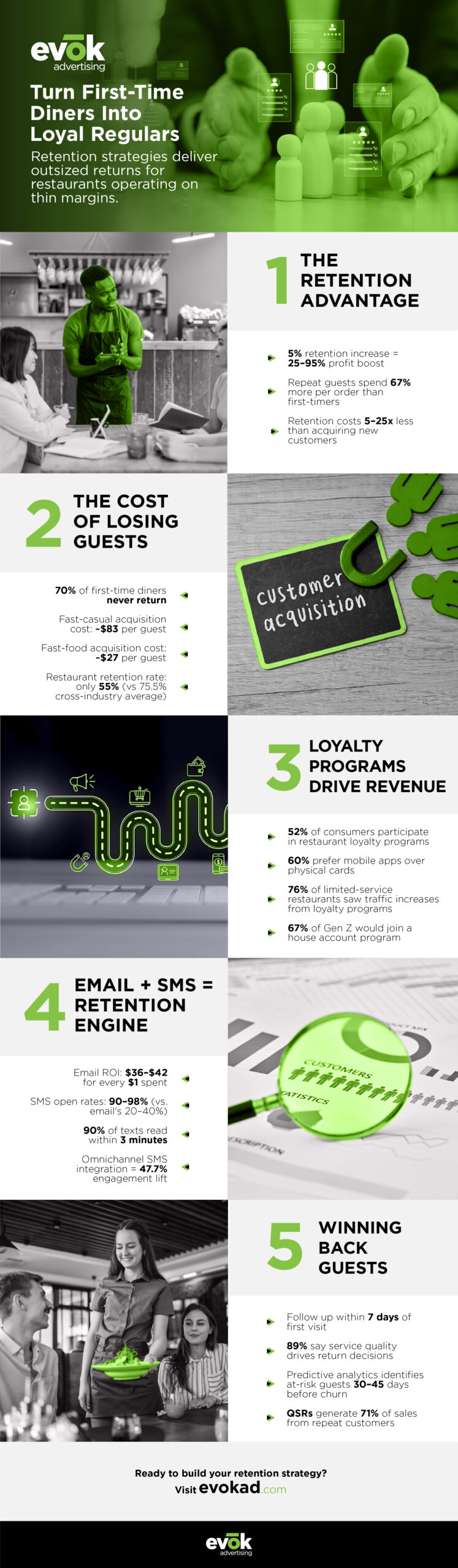
According to the Harvard Business Review, a 5% increase in customer retention can boost profits by 25% to 95%, depending on the industry. For restaurants operating on thin margins, that kind of leverage represents the difference between struggling to break even and building sustainable profitability.
Existing customers also spend more per visit. Industry data shows repeat guests spend 67% more per order than first-time visitors, making each return visit exponentially more valuable than the initial trial.
Key Takeaway: Restaurant retention improvements deliver compound returns through both increased visit frequency and higher per-visit spending, making retention one of the highest-ROI marketing investments available.
Customer Acquisition Costs by Restaurant Segment
The reality of customer acquisition costs hits restaurants particularly hard. According to industry research, fast-casual concepts face an average paid customer acquisition cost of approximately $83 per guest, while fast-food brands spend around $27 per new customer. When first-time guests visit once and never return, those acquisition dollars evaporate.
Research from Bain & Company shows that acquiring a new customer costs 5 to 25 times more than retaining an existing one, making retention strategies significantly more cost-effective than perpetual acquisition campaigns.
Key Takeaway: With acquisition costs ranging from $27 to $83+ per guest and retention costing 5-25x less, restaurants lose the majority of their marketing investment when they fail to convert first-time visitors into repeat customers.
Quick-service restaurants understand this dynamic well. According to the National Restaurant Association, QSRs generate approximately 71% of their sales from repeat customers, compared with 68% in fast casual, 64% in casual dining, and 51% in fine dining. Marketing strategies that prioritize retention over pure acquisition align spending with where revenue actually originates.
What Does Customer Retention Mean for Restaurant Revenue?
Research from Bain & Company, cited in Harvard Business Review, found that increasing customer retention rates by just 5% can boost profits by 25% to 95% (Harvard Business Review). For restaurants operating on thin margins, this makes retention one of the most powerful levers for profitability.
- Acquisition costs significantly more: Acquiring a new customer costs 5 to 25 times more than retaining an existing one, according to research published in Harvard Business Review (Harvard Business Review)
- Repeat customers drive the majority of sales: The National Restaurant Association reports that quick-service restaurants generate roughly 71% of sales from repeat customers, compared to 68% in fast-casual, 64% in casual dining, and 51% in fine dining (National Restaurant Association)
- Most first-time diners never return: Industry data shows approximately 70% of first-time restaurant guests never come back, highlighting the critical need for stronger initial engagement strategies (Milagro)
Retention Performance by Segment: The hospitality, restaurant, and travel sector has the lowest customer retention rate of any major industry, retaining only 55% of customers compared to 84% in media and professional services (ThinkImpact). The average restaurant industry retention sits significantly below the global cross-industry benchmark of 75.5%.
Understanding the Customer Journey: From First Visit to Loyal Regular

The path from first-time visitor to loyal regular follows predictable behavioral stages that CMOs can systematically influence. Understanding where guests fall on this journey, and what triggers progression to the next stage, enables precision marketing that moves customers toward higher lifetime value tiers rather than letting them drift away after a single transaction.
At evok, we structure restaurant marketing programs around the “Trial to Ambassador” model. This framework recognizes that guest progression isn’t random, it responds to deliberate marketing interventions at each stage. A first-time visitor needs different messaging than an occasional guest who has visited three times but not in six weeks.
Why the Second Visit Is Your Most Important Conversion
The second visit represents the single most important conversion in the customer journey. Moving a guest from one-time visitor to occasional visitor status dramatically increases lifetime value, yet most restaurants invest nothing in making this conversion happen. Instead, they direct all their marketing energy toward acquiring new first-timers.
Smart operators flip this equation, treating second-visit conversion as their highest-priority marketing objective and building dedicated campaigns around that specific behavioral trigger.
Key Takeaway: Restaurants should allocate dedicated marketing resources to second-visit conversion campaigns, as this single behavioral trigger has the greatest impact on customer lifetime value.
Creating Memorable First Impressions That Encourage Return Visits

The first visit sets expectations that determine whether guests consider returning. Operational execution during this initial experience creates the foundation for all future marketing efforts. No amount of promotional spending can overcome a mediocre first impression, while an exceptional debut experience makes subsequent retention marketing far more effective.
Service Quality as the Primary Retention Driver
Research shows that 89% of customers say excellent customer service influences their decision to return, making service quality the primary driver of retention regardless of cuisine type or price point. This finding holds across segments, though the specific service elements that matter vary.
QSR guests prioritize speed and order accuracy, while full-service guests place greater emphasis on hospitality and attentiveness, expecting staff to anticipate their needs and create memorable moments.
Key Takeaway: Service quality drives 89% of return visit decisions, but the specific elements that matter (speed, accuracy, or hospitality) vary by restaurant segment.
The Post-Visit Follow-Up Window
The post-visit window offers a critical opportunity that most restaurants neglect entirely. Sending a personalized follow-up message within 7 days of the first visit can dramatically increase the likelihood of a return. This message should acknowledge the visit, thank the guest for choosing your restaurant, and provide a compelling reason to return, whether that’s a time-limited offer, an invitation to try a different menu category, or simply a reminder of what made the experience special.
When Miller’s Ale House partnered with us to promote summer menu LTOs, 80% of traffic came from mobile devices, highlighting how digital discovery leads to in-person visits that must deliver on the brand promise.
Building Effective Restaurant Loyalty Programs That Drive Frequency

Loyalty programs have evolved from simple punch cards to sophisticated behavioral engines that drive measurable revenue growth. The National Restaurant Association’s 2024 State of the Industry report found that 52% of consumers participate in restaurant loyalty programs, with members visiting more frequently and spending more per visit compared to non-members.
Key Elements of High-Performing Loyalty Programs
Program design matters more than program existence. The most effective restaurant loyalty programs share several characteristics that distinguish them from generic discount mechanisms. They make enrollment frictionless, ideally happening automatically at checkout or through a quick QR code scan. They provide immediate value upon joining, giving new members a reason to return before they’ve even left the restaurant. And they create clear progression paths that motivate continued engagement.
Key Takeaway: Successful loyalty programs combine frictionless enrollment, immediate value delivery, and clear progression mechanics to drive sustained engagement rather than one-time signups.
Mobile Integration and Loyalty Program Performance
Mobile integration has become essential for loyalty program success. According to the National Restaurant Association, 60% of current loyalty program users prefer using smartphone apps rather than carrying physical cards.
The convenience factor alone drives participation, but mobile platforms also enable personalization features unavailable in traditional programs, push notifications based on location or time of day, personalized offers based on order history, and gamified challenges that drive engagement between visits.
Key Takeaway: Mobile-first loyalty programs generate higher customer engagement while enabling advanced personalization capabilities that traditional card-based programs cannot match.
Creating Tiered Structures That Sustain Engagement
Tiered structures create aspiration that sustains engagement over time. When guests understand what’s required to reach the next reward level, they modify their behavior to hit those thresholds. The psychological principle of the goal gradient effect means guests accelerate engagement as they approach milestones, creating predictable spikes in visit frequency around reward thresholds.
Smart program design places these thresholds at intervals that maintain motivation without making achievement feel impossible. The data-capture opportunities loyalty programs provide may be more valuable than the direct revenue impact, every transaction through the loyalty platform generates behavioral intelligence that enables targeted campaigns far more effective than generic promotions.
How Effective Are Restaurant Loyalty Programs?
According to the National Restaurant Association’s 2024 Restaurant Technology Landscape Report, 52% of consumers already participate in restaurant loyalty programs, with 96% of loyalty program members saying they’re a good way to earn more value (National Restaurant Association).
- Loyalty drives traffic: Many adults say being part of a loyalty program influences where they choose to dine (National Restaurant Association State of the Industry 2025)
- Operators see real results: 76% of limited-service restaurants registered an increase in traffic in 2024, driven by their loyalty program (Nation’s Restaurant News)
- Widespread adoption: 61% of restaurant operators now offer loyalty programs, with 46% planning to update or enhance their programs in 2025 (National Restaurant Association)
Consumer Preferences:
- Mobile-first engagement: 60% of current loyalty program users prefer using smartphone apps rather than carrying physical cards (National Restaurant Association)
- Delivery decision factor: 61% of restaurant customers say a loyalty program is an important factor when choosing a restaurant for a delivery order (Nation’s Restaurant News)
- Generational opportunity: 67% of Gen Z adults say they would participate in a house account program (Restaurant Dive)
The data shows loyalty programs have evolved from nice-to-have perks to essential business drivers that directly impact customer traffic and revenue.
Using Customer Data to Personalize Marketing and Increase Retention

Personalization has moved from a competitive advantage to a baseline expectation. According to McKinsey research, personalization can reduce customer acquisition costs by up to 50% and lift revenue by 5% to 15%. For restaurants, this means generic mass marketing no longer generates acceptable returns.
Building Unified Customer Data Profiles
The foundation of effective personalization is unified customer data. Most restaurants suffer from fragmented systems where POS transactions, online ordering, reservations, WiFi logins, and loyalty program activity exist in separate silos. Customer Data Platforms solve this problem by aggregating information from every touchpoint into comprehensive guest profiles.
When you know that a specific guest orders appetizers on 75% of visits, prefers Tuesday dinners, and hasn’t visited in 45 days, you can trigger automated campaigns with precision impossible through generic marketing.
Behavioral Segmentation vs. Demographic Targeting
Segmentation strategies built on behavioral data outperform demographic targeting by significant margins. Instead of broad categories like “millennials” or “families,” behavioral segmentation creates actionable groups, such as “lunch regulars who haven’t tried dinner” or “high-value guests showing declining visit frequency.”
These segments respond to different messaging because they reflect actual preferences rather than assumed characteristics. A guest whose behavior indicates price sensitivity needs different offers than one whose history suggests they respond to exclusivity and early access.
Key Takeaway: Behavioral segmentation based on actual purchase patterns delivers higher marketing ROI than demographic assumptions by enabling precise, relevant messaging for each customer group.
Leveraging Predictive Analytics for Proactive Retention
Predictive analytics takes personalization from reactive to proactive. Machine learning models can identify guests at risk of churning 30 to 45 days before they would typically defect, enabling intervention campaigns while the relationship is still salvageable.
The personalization opportunity extends to menu recommendations, promotional offers, and communication timing. Guests who consistently order a specific appetizer should see targeted upsell suggestions for complementary items. Those who visit during lunch but never dinner represent cross-daypart expansion opportunities. High-frequency guests merit VIP recognition that reinforces their importance to your business.
Email and SMS Strategies for Staying Top-of-Mind With Past Guests

Email and SMS remain the highest-ROI channels for restaurant retention marketing despite the proliferation of newer platforms. Email marketing delivers an average return of $36to $42 for every dollar spent, while SMS achieves open rates of 90% to 98% compared to email’s 20% to 40%.
SMS Marketing Performance for Restaurants
SMS excels for time-sensitive communications that demand immediate attention. Restaurant SMS campaigns in the food and beverage industry increase engagement rates by 25%, with abandoned cart messages achieving click-through rates of 10% to 14%.
The channel works particularly well for flash promotions during slow periods, reservation reminders, order-ready notifications, and last-minute table availability alerts. The immediacy of SMS creates urgency that email cannot match, making it ideal for driving same-day traffic.
Key Takeaway: SMS marketing delivers 90-98% open rates and 25% higher engagement for restaurants, making it the optimal channel for time-sensitive promotions and same-day traffic generation.
Managing Message Frequency and Automation
Frequency management prevents fatigue that leads to unsubscribes and opt-outs. According to consumer research, 40% of people feel that one text message per week from businesses is appropriate. The key is ensuring every message provides value rather than simply asking for a transaction.
Automation makes sophisticated email and SMS programs operationally feasible. Pre-built campaign workflows trigger based on guest behavior without requiring manual intervention, a new loyalty member automatically enters a welcome sequence, a guest whose visit frequency drops triggers a re-engagement campaign, and a VIP approaching their anniversary receives a celebration offer.
How Do Email and SMS Perform for Restaurant Marketing?
According to the Data & Marketing Association, email marketing delivers an average ROI of $10 to $36 for every $1 spent, making it one of the highest-return marketing channels available (Data & Marketing Association via Litmus). For restaurants focused on retention, this cost-effectiveness is critical.
- Email delivers strong returns: The retail, ecommerce, and consumer goods sectors see ROI as high as $36 for every $1 spent on email marketing (Litmus State of Email 2025)
- Frequency matters: Sending 5-8 emails per month provides the highest ROI, averaging $48 per $1 spent (EmailTooltester)
- Customer preference: 55% of consumers prefer email as their most preferred means of communication when receiving marketing content from businesses (Constant Contact)
SMS Marketing Performance:
- Near-universal visibility: SMS messages achieve open rates between 90% and 98%, compared to email’s average of 20-28% (Forbes via Infobip)
- Rapid engagement: 90% of SMS messages are read within three minutes of delivery (Validity via Infobip)
- Higher response rates: SMS achieves a 45% response rate compared to email’s 6%, making it approximately 7.5 times more effective for driving immediate action (Business.com via Infobip)
Combined Channel Strategy:
- Purchase impact: 72% of consumers report making a purchase after receiving a text from a brand (Klaviyo via Omnisend)
- Omnichannel lift: Brands that integrate SMS into their omnichannel strategies see a 47.7% lift in customer engagement (Omnisend)
For restaurants, the combination of email for relationship-building and SMS for time-sensitive offers creates a retention engine that meets customers where they are.
Measuring Restaurant Customer Retention: Key Metrics and Benchmarks

What gets measured gets managed, and retention measurement requires specific KPIs that most restaurant operators don’t track systematically. The fundamental metrics include customer retention rate, guest lifetime value, visit frequency, and churn rate.
Industry Retention Rate Benchmarks
Customer retention rate measures the percentage of guests who return within a defined period, typically 90 days for restaurants. Industry data indicates that the average restaurant retention rate sits at approximately 55%, well below targets across all segments, indicating a massive opportunity for operators who prioritize improvement.
Key Takeaway: With average restaurant retention significantly below cross-industry benchmarks, even modest improvements represent significant revenue opportunities for operators who implement systematic retention strategies.
Tracking Guest Lifetime Value and Churn
Guest lifetime value quantifies the total revenue expected from a customer over their entire relationship with your restaurant. The calculation multiplies average visit spend by visit frequency by retention duration. Tracking GLV by acquisition source, segment, and time period reveals which marketing investments generate the highest-value customers rather than simply the most customers.
Churn rate tracks the percentage of previously active guests who stop visiting. Identifying at-risk guests before they churn requires predictive modeling based on changes in visit patterns, declining frequency, or extended gaps between visits. Automated win-back campaigns triggered by these signals can recover a meaningful share of at-risk guests who would otherwise be permanently lost.
Using Cohort Analysis to Optimize Acquisition
Cohort analysis tracks how different groups of guests behave over time. Guests acquired through specific campaigns, during particular seasons, or from different channels often show distinct retention patterns. Understanding these differences enables optimization of acquisition strategies to attract guests more likely to become regulars rather than one-time visitors.
The most sophisticated operators track acquisition costs by cohort and compare them to cohort lifetime value, ensuring they invest in sources that generate positive long-term returns rather than simply maximizing initial traffic volume.
Frequently Asked Questions About Restaurant Customer Retention
What is a good customer retention rate for restaurants?
Retention rate targets vary by segment. Quick-service restaurants typically aim higher given the habitual nature of QSR visits, while casual and fine dining see lower rates due to occasion-based visit patterns. Regardless of your current baseline, any meaningful improvement represents a significant revenue opportunity since retained guests consistently outspend new customers.
How much does it cost to acquire a new restaurant customer versus retaining one?
Customer acquisition costs substantially more than retention across most industries, with restaurants facing particularly high acquisition expenses of $27 to $83+ per guest. Retention marketing targets guests who have already demonstrated purchase intent, achieving far higher conversion rates than campaigns aimed at new prospects.
What is the best loyalty program structure for restaurants?
The most effective loyalty programs combine low-friction enrollment, immediate value delivery, clear progression mechanics, and mobile-first design. Points-based systems work well for QSR and fast-casual concepts, tiered structures suit full-service restaurants, and subscription models generate predictable revenue while driving visit frequency.
How quickly should restaurants follow up after a first visit?
The first week after an initial visit represents the critical window for conversion. Automated email or SMS within this period dramatically increases return probability. Best practice includes a thank-you message within a day or two followed by a return incentive before the week ends.
Building a Retention-Focused Culture That Drives Long-Term Growth

Customer retention isn’t a campaign or a tactic, it’s a strategic orientation that permeates every aspect of restaurant operations and marketing. The concepts that achieve industry-leading retention rates don’t just run loyalty programs or send automated emails. They build organizations where every team member understands the economics of repeat business and takes ownership of guest relationships.
The financial case for retention investment has never been stronger. With acquisition costs rising, third-party platform commissions eroding margins, and guest attention increasingly fragmented, the path to sustainable profitability runs through existing customer relationships rather than perpetual acquisition spending.
At evok, we’ve built our restaurant marketing practice around helping brands navigate this shift from acquisition-focused to retention-focused strategies. Our “Trial to Ambassador” framework provides the behavioral mapping and campaign architecture that systematically moves guests up the value ladder. The restaurants that will thrive recognize that their most valuable marketing asset isn’t their social media following or their advertising budget, it’s their existing customer base. Ready to turn first-time guests into loyal regulars? Contact our team to start building your retention strategy.