


Healthcare Social Media Marketing: Platform Strategies That Build Trust and Drive New Patient Appointments

Healthcare social media is often misjudged by retail marketing standards that equate reach and engagement with revenue. Instead, patients approach healthcare decisions with high caution, meaning social channels quietly influence provider selection in ways standard reporting fails to capture.
Rather than a discovery tool, social media acts as a verification layer. Patients arriving from searches, insurance directories, or recommendations check profiles to confirm an organization is current, legitimate, and trustworthy. Consequently, trust (built through modest, clinician-led content) outperforms broad reach from automated accounts.
Healthcare marketing operates under unique constraints, including strict HIPAA rules for posts and replies, restrictive platform policies for paid ads, and privacy exposures in tracking infrastructure. Navigating platform selection, compliance, provider visibility, moderation, paid strategy, and attribution equips leaders to prove if these efforts actually acquire patients.
Why Social Media Has Become a Primary Trust Signal in Patient Provider Selection

Most patients use social media to verify providers found via search, directories, or referrals rather than discovering them there. They seek proof that a practice is active and staffed by authentic, approachable people. Consequently, profiles acting as a verification layer can significantly influence decisions even with minimal measurable traffic. This function makes the channel highly valuable for healthcare marketing leaders.
The reach makes this difficult to opt out of. Pew Research Center’s 2025 survey of more than 5,000 U.S. adults found that 84% use YouTube and 71% use Facebook, which means nearly every prospective patient already holds an account somewhere a practice could be evaluated. Absence registers as a signal too. A profile that stopped posting 14 months ago tells a patient something about the organization, and what it tells them is rarely favorable.
What patients actually assess during that check is narrower than most content calendars assume. They look at whether posts are recent, whether the people in the photos appear to work there, whether providers show up as identifiable individuals rather than stock imagery, and how the organization responds when someone posts a complaint in the comments. The tone of a reply to an unhappy commenter carries more weight than a month of educational carousels, because it demonstrates behavior rather than describing values.
This verification function has grown more important as review volume has thinned out at many practices. Patients rely heavily on reviews but contribute few of their own, and 57% say they rarely or never leave one. A practice with six reviews and an active, human social presence often reads as more trustworthy than one with six reviews and nothing else, since the patient fills the evidence gap with whatever is visible.
For healthcare CMOs, the practical consequence is a measurement problem. Follower counts and impressions describe reach, and reach is not what the channel is producing here. The more useful question is whether the profile holds up under a 90-second audit by a skeptical person deciding where to send their family, which is a standard most healthcare accounts have never been evaluated against.
What Percentage of Patients Research Providers on Social Media Before Booking?
Roughly a third of patients now factor social presence into provider selection, with 35% saying they have chosen a doctor based on that provider’s social media presence in a 2025 survey of more than 1,000 U.S. patients. Another 24% named social media as a top influence when selecting a new provider, and 18% started using it to research doctors within the previous year. The adoption curve matters as much as the total because it indicates the behavior is still expanding rather than holding steady.
Platform Selection for Healthcare: Matching Facebook, Instagram, LinkedIn, and TikTok to Practice Type

Platform selection in healthcare is decided by patient age far more than by content preference. Pew Research Center’s 2025 survey shows the spread plainly: half of U.S. adults use Instagram, but that drops to 19% among adults 65 and older, while YouTube and Facebook are the only platforms a majority in every age group uses. A geriatric practice and a pediatric dental group operating identical content strategies on identical platforms will produce very different results, and neither one is executing badly.
Facebook anchors local search presence and absorbs patient questions. For multi-location systems, single system-level pages dilute local relevance, while separate location pages increase the moderation workload.
Instagram benefits practices where the physical facility and care team influence decisions, including dermatology, dental, orthodontics, women’s health, and physical therapy. Visual proof of a modern facility and happy staff succeeds where copy cannot.
LinkedIn serves as a referral and recruitment infrastructure rather than a patient acquisition. Specialists reach referring physicians, and health systems efficiently recruit clinical staff in tight labor markets. Using it as a patient platform misallocates healthcare social budgets.
TikTok requires a clearer-eyed assessment than it usually gets. Pew puts adoption at 37% of U.S. adults, and the reach is real for practices targeting patients under 35, where clinician-led educational content performs unusually well. The institutional risk is also real: public health systems, academic medical centers, and organizations with government affiliations face device restrictions and board-level scrutiny that independent practices do not. Organizations without those constraints should evaluate it on merit, and organizations with them should not spend six months building a case for a platform their governance will reject.
Which Social Platforms Deliver the Highest Engagement for Healthcare Content?
Instagram delivers the strongest engagement for healthcare organizations, peaking at a 3.89% engagement rate at a posting frequency of just 2 posts per week in Hootsuite’s benchmark research. Facebook tops out at 2.22% at that same cadence, well below Instagram despite absorbing far more of the average organization’s effort. Healthcare organizations post to Facebook an average of 11.4 times per week, which puts most of them well past the point where added volume improves anything.
HIPAA Compliance on Social Media: What Healthcare Organizations Can and Cannot Post

The rule that catches marketing teams is narrower than most people expect. HIPAA allows covered entities to use and disclose protected health information for treatment, payment, and health care operations without prior authorization. Marketing sits outside that permission set, which means any patient-identifying content in a promotional post requires a valid written authorization obtained before publication, not after someone objects.
The enforcement record on this is specific. OCR settled with five Delaware providers operating as Cadia Healthcare Facilities in September 2025 after finding they had published the PHI of 150 patients through a “success story” program without valid written authorizations, including names, photographs, and details of conditions, treatment, and recovery. The settlement carried a payment of $182,000 and a corrective action plan monitored by OCR for two years. Notably, the plan required HIPAA training for workforce members, including marketing personnel, which signals how OCR views the function.
Most exposure comes from three failure modes that do not initially appear to be violations. Public patient posts do not permit organizational reposting. Comment replies confirming patient care, such as “thanks for trusting us with your knee replacement,” also count as unauthorized disclosures. Lastly, uninspected facility photos often accidentally display incidental PHI on whiteboards, monitors, printed schedules, and chart covers.
Organizations underutilize highly compliant content options that bypass patient authorization entirely. Healthcare groups can build a year of material without any patient involvement by using general health education, service line explanations, provider credentials, tours, community events, hiring news, and consented staff features. Recognizing this early prevents compliance reviews from unnecessarily stopping campaigns.
When patient authorization is required, the document must be rigorous. It should specify the data used, outline its placement, and reside in the patient’s record instead of a marketing file. Because state laws introduce strict criteria beyond federal rules, compliance counsel must review all language and retention practices.
What Patient Information Can Healthcare Organizations Legally Share on Social Media?
Almost none without written authorization first, a standard OCR enforced when it assessed $182,000 against Cadia Healthcare Facilities for publishing the PHI of 150 patients without valid authorizations in September 2025. PHI covers names, photographs, dates of service, conditions, and treatment details, so identifiable patients require paperwork and everything else does not. General education, provider credentials, facility content, and staff features carry no patient authorization requirement at all.
Building Provider Visibility: Turning Clinicians Into Trusted Voices on Social Platforms
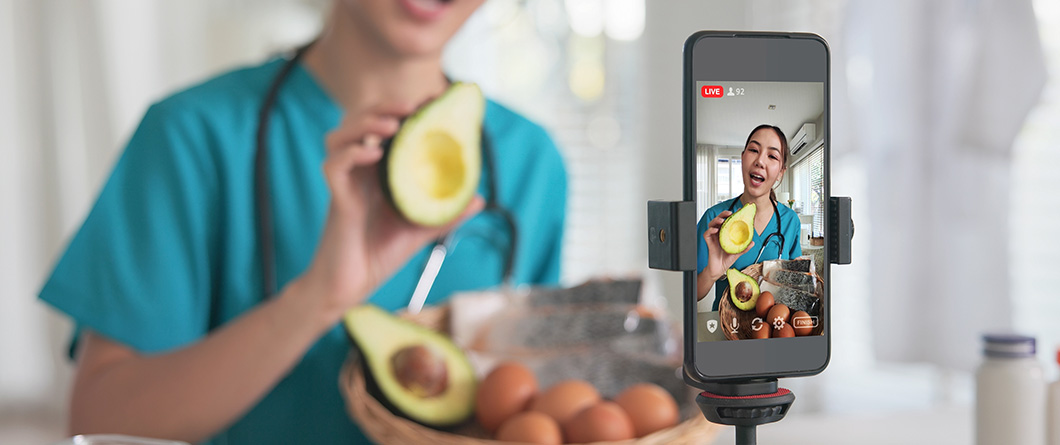
Trust in healthcare attaches to people with credentials, not to organizational logos. Annenberg survey data reported by the American Medical Association found that physicians and medical organizations remain among the most trusted sources of public health information, with about 73% of Americans expressing confidence in the AMA even as confidence in federal health agencies has declined. That credibility belongs to clinicians and transfers only weakly to the brand account posting on their behalf.
A health system explaining a rotator cuff repair performs differently than the surgeon who does it explaining it in the same words. Patients want human proof of competence, which an institutional profile cannot replicate.
Marketing leaders can solve clinical time constraints by extracting content rather than asking providers to create it. A single 90-minute session answering 15 common exam room questions yields a quarter of short-form content. The marketing team manages scripting, editing, and scheduling, making an afternoon commitment acceptable to busy providers.
Guardrails must precede the first shoot. Content should remain general and educational. Answering specific symptom questions in comments introduces organizational risk, and scope-of-practice statements require regular marketing review. Written guidelines give clinicians confidence, whereas ambiguity causes silence.
Address provider departure early. Usage agreements must define rights after employment ends, and periodic audits should remove or archive content featuring former clinicians. Neglecting this creates profiles promoting departed physicians, undermining institutional credibility.
Which Content Format Builds the Most Patient Trust on Healthcare Social Media?
Educational content delivered by credentialed clinicians outperforms every other format, largely because the alternative sources are poorly trusted: KFF polling found that fewer than half of users say they find at least some of the health information on these platforms trustworthy, and just 15% of social media users turn to influencers for health information and advice. The gap between how much health content circulates and how little of it people believe leaves an opening that credentialed providers are positioned to fill. Testimonials and promotional posts do not close it, since neither carries clinical authority.
Content Pillars for Healthcare Social: Balancing Education, Community, and Practice Promotion

Specific promotional content (15% split) focuses on concrete details like service, location, and availability to enable direct tracking. Excessive promotional volume causes audiences to lose interest, so restricting it safeguards overall calendar performance. Awareness observances should act as hooks for distinct education rather than superficial content. For multi-location systems, central teams should handle education and promotion while local facilities contribute community content through a narrow, simple approval lane.
Community Management and Comment Moderation: Responding Without Violating Patient Privacy

Moderation is where healthcare social media generates most of its real risk, and it usually falls to whoever happens to have the login. The exposure comes from the fact that a public reply confirming someone received care is a disclosure, so the friendly instinct that makes a good community manager in other industries is the exact instinct that creates a problem here. Teams need a script before they need a strategy.
The safe pattern acknowledges the person without acknowledging the relationship. A reply that thanks someone for sharing, expresses that the organization takes feedback seriously, and offers a private channel accomplishes the social function without confirming anything. Language like “we’d like to learn more, please reach our patient experience team at the number below” works for a complaint from an actual patient and for a complaint from someone who has never walked through the door, which is the point.
Most incoming comments sort into five categories, and each one has a different correct handling:
- General questions about services, hours, insurance, or location. Answer publicly and completely, since nothing here is patient-specific, and public answers help everyone reading.
- Complaints or negative reviews. Acknowledge, do not confirm care, and move it private within one response rather than negotiating in the thread.
- Clinical questions about the commenter’s own symptoms. Do not answer, since a public clinical response may appear to establish a care relationship. Direct them to call the office or seek care.
- Comments where a patient discloses their own PHI. Leave their words alone and do not repeat any details back, because the act of repeating them constitutes a disclosure, even when the patient volunteered them first.
- Language suggesting an emergency or crisis. Escalate immediately under a documented protocol, direct the person to emergency services, and never let this sit in a queue overnight.
That last category is the one that needs a written procedure and a named owner. Social accounts receive messages describing chest pain, suicidal ideation, and medication reactions, and the organization needs a decision made in advance about who gets contacted, how fast, and what the response says. A protocol written on a calm Tuesday is worth considerably more than judgment exercised at 11 p.m. by a coordinator who has never faced it.
Hiding, deleting, and leaving are three different tools. Hiding suppresses a comment from the public while keeping it visible to the commenter, which avoids the escalation that deletion often triggers. Delete only for content that violates platform rules or exposes a third party’s information, and leave ordinary criticism visible, since a page with no negative comments reads as curated rather than trustworthy.
Multi-location systems should route escalation upward rather than outward. Location staff handle general questions; anything involving a complaint or clinical content moves to a central team with compliance access, and the path should be one step rather than three.
Paid Social for Healthcare: Targeting Restrictions and Campaign Strategies for Patient Acquisition

Healthcare paid social operates under a constraint that reshapes everything downstream: you cannot tell the platform which condition your audience has, and you cannot write copy suggesting you know. Meta’s advertising standards prohibit ads that imply knowledge of medical information about a user or their family, covering both direct and indirect assertions about physical or mental health. The rejection usually arrives without explanation, which is why healthcare accounts accumulate disapprovals that nobody on the team can diagnose.
The solution is usually a rewrite rather than an appeal. Copy that addresses readers as individuals with a condition fails, while copy describing a service, benefit, or general health topic passes. Meta policy allows “you” language if no personal attribute is attached and references health topics broadly without asserting personal or family conditions. For instance, “struggling with joint pain?” is rejected, whereas “orthopedic care, now scheduling in three locations” passes to the same audience.
Targeting relies on remaining available parameters. Geography is vital in healthcare because physical service areas and drive times predict conversions effectively. Age brackets match service lines well, broad interest categories remain functional, and non-clinical first-party audiences (like newsletters or events) are permitted. Conversely, building custom audiences from clinical system data is prohibited and must be strictly regulated by policy.
Lead forms deserve specific attention because they are where compliant campaigns go wrong. Meta’s standards prohibit lead ad form fields asking whether a person has experienced mental health issues or about current or past disabilities, and the same reasoning extends to any field capturing condition detail. Collect enough to make contact and nothing more, then gather clinical information inside systems built to hold it.
Measurement runs into the same wall, since health-category advertisers face restrictions on lower-funnel conversion events that limit what can be optimized toward. Campaigns built around awareness, traffic, and reach hold up better than conversion-optimized structures that lose signal, and server-side implementation through the Conversions API gives more control over what leaves the website than a browser pixel does. Creative carries risk too, and before-and-after imagery, depictions of the condition being treated, and body-focused framing all draw scrutiny that lifestyle and facility imagery avoids.
Measuring Healthcare Social Media Performance: From Engagement to Booked Appointments

Most healthcare social reporting stops at the top of a five-step ladder. The full path runs from engagement to profile actions, then to site sessions, then to booking starts, then to completed appointments, and each step down that ladder tells a CMO something the step above it cannot. Reporting that ends at impressions and follower growth leaves the channel permanently vulnerable at budget time, since nobody can defend a line item measured only by activity.
Healthcare hits a complication other industries do not, because the tracking layer that produces clean attribution is the same layer that carries privacy exposure. OCR issued guidance in December 2022 treating certain tracking data on health-related webpages as protected information, revised it in March 2024, and a federal court vacated part of it that June. HHS has since noted on its own guidance page that the court declared unlawful and vacated the portion covering an IP address combined with a visit to an unauthenticated public webpage about health conditions or providers, and the agency withdrew its appeal in August 2024.
Standard analytics on public marketing pages sit on firmer ground than in 2023, but everything behind a login remains fully in scope. Third-party pixels do not belong on patient portals, authenticated scheduling flows, or any page where users identify themselves; organizations should audit legacy configurations rather than assuming court rulings resolved them.
This constraint drives healthcare toward attribution methods that bypass clinical systems. Channel-specific phone numbers track social-driven calls missed by standard analytics, disciplined UTM tagging separates organic from paid platforms, and intake form capture (asking patients how they found the practice) provides valuable data no pixel can replicate.
For board reporting, two key metrics carry the argument: cost per new patient by channel to compare social with paid search and referral development, and the share of new patients citing social at intake. For the clearest causal evidence, organizations can run geographic holdout tests by pausing social in one market while sustaining it in another.
Building this measurement layer requires coordination across marketing, compliance, IT, and scheduling, which frequently stalls inside organizations. Evok builds compliant content systems, provider visibility programs, moderation protocols, and appointment attribution. Reach out to discuss what your social presence should be producing.
How Do Healthcare Organizations Attribute Appointments to Social Media?
Through self-reported intake capture, channel-specific call tracking, and UTM tagging rather than pixel-based conversion tracking, because HHS guidance still treats tracking technologies on authenticated pages and patient portals as subject to HIPAA obligations even after a 2024 court ruling narrowed the portion covering public webpages. Asking new patients how they found the practice produces attribution data that survives any regulatory shift. Geographic holdout testing gives the strongest causal evidence when budget defense requires it.
Frequently Asked Questions About Healthcare Social Media Marketing
How often should a healthcare practice post on social media to maintain visibility?
Two to three times per week on your primary platform is the realistic target, and the benchmark data supports restraint over volume. Healthcare organizations reach their highest Instagram engagement at 2 posts per week, with Facebook following the same pattern, so the practice posting daily is likely working harder for less. Consistency matters more than frequency, since a profile that goes dark for six weeks does more damage than one posting twice weekly all year.
Who should manage social media at a healthcare organization, marketing staff or clinicians?
Marketing staff should own the account, and clinicians should appear in the content. Splitting it this way solves both constraints at once, since marketing has the time and the platform knowledge while clinicians carry the credibility patients respond to. Moderation in particular should never sit with clinical staff, because a provider replying to a comment can inadvertently create the appearance of a care relationship.
What annual social media budget should a healthcare practice plan for?
Budget across four line items rather than one number: content production, paid amplification, management and analytics tooling, and staff time for moderation coverage. Content production is usually the largest and the most compressible, since a batched approach, filming several providers in one session, costs a fraction of ongoing individual shoots. Paid amplification should be sized against your cost per new patient in other channels, because social competes with paid search and referral development for the same acquisition dollars.
How do multi-location health systems coordinate social media across facilities?
Give locations a narrow lane rather than a full calendar. Education and promotional content produced centrally travels well across facilities, while community content needs local ownership because sponsorships, staff milestones, and neighborhood events do not scale from a corporate account. Pair that with a one-step escalation path so location staff handles general questions and anything involving complaints or clinical content routes to a central team with compliance access.
What social media policies should healthcare organizations set for employee personal accounts?
Policies should cover three things: no PHI in any personal post, no confirmation that a specific individual is a patient, and no photography inside clinical areas without review of what appears in frame. Employees also need clarity on whether they can identify their employer on personal profiles and what happens when patients send them friend requests. Training should reach every workforce member, not just clinical staff, since OCR’s corrective action plan in the Cadia settlement specifically required training for marketing personnel.
How long does healthcare social media take to generate new patient appointments?
Expect six to nine months before attribution data shows meaningful appointment volume, with earlier signals appearing in profile actions and site traffic. The channel works as a verification layer for patients who found the practice elsewhere, which means much of its contribution shows up as improved conversion in other channels before it produces direct bookings. Organizations that judge it on direct attribution alone at the 90-day mark almost always conclude it is failing.