


Credit Union Mobile Banking Marketing Guide: Meeting Members Where They Are in 2026
Mobile banking has shifted from a convenience feature to the primary way most members interact with their financial institutions. For credit unions, this shift represents both an urgent challenge and a significant growth opportunity. The institutions that treat mobile as their most important member touchpoint will capture market share, while those who treat it as an afterthought will watch members migrate to competitors.
The gap between credit unions and their competitors is widening. Regional banks and national institutions have invested heavily in digital sales channels. Fintech apps have trained consumers to expect instant account opening, real-time notifications, and frictionless money movement. Younger members are quick to leave when expectations go unmet, often considering national banks or digital-only providers when their current institution falls short.
For CMOs, this reality points toward a clear priority. Mobile banking is no longer the sole responsibility of IT. It requires coordinated marketing investment to drive downloads, encourage adoption, communicate value, and build the kind of trust that keeps members engaged over time. The credit unions winning in 2026 understand that mobile is where first impressions form, where daily engagement happens, and where long-term loyalty is either earned or lost.
Understanding Mobile Banking Adoption Trends and Member Expectations

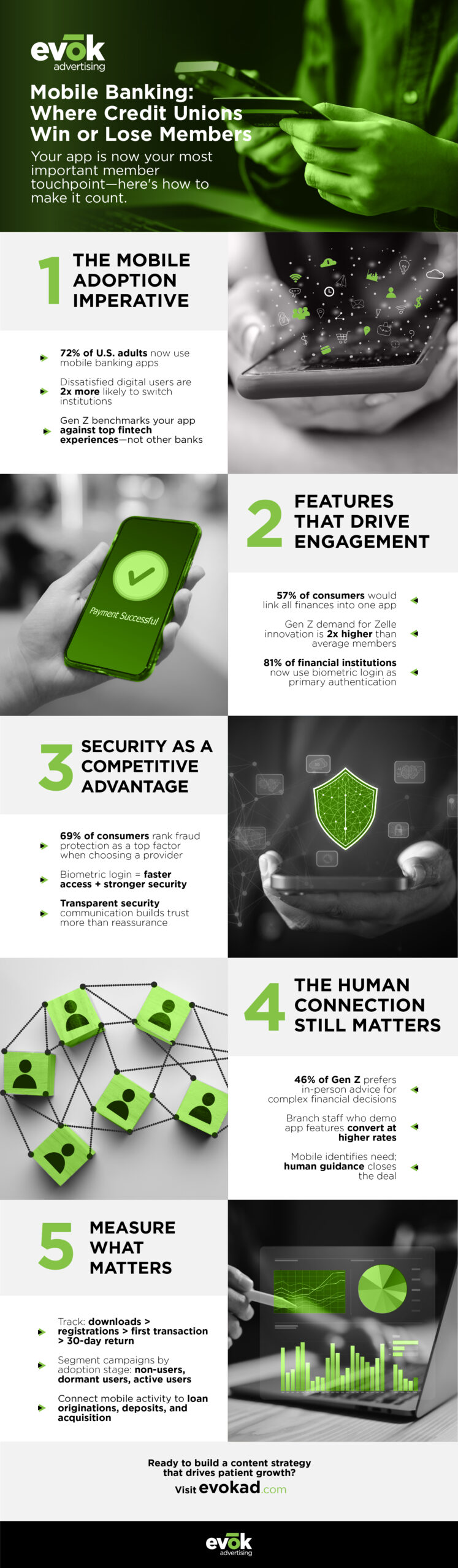
Mobile banking adoption has reached a tipping point. As of 2025, 72% of U.S. adults report using mobile banking apps. These figures reflect a fundamental change in how people expect to manage their money: on their terms, on their schedule, from wherever they happen to be.
Gen Z Mobile Banking Expectations
Gen Z consumers expect their financial institutions to anticipate needs, offer personalized insights, and deliver information quickly. They view AI-powered financial tools as everyday utilities rather than experimental features. This generation evaluates credit unions against the seamless experiences they encounter with leading consumer apps.
Key Takeaway: Credit unions must benchmark their mobile experience against fintech standards, not just other financial institutions, to meet Gen Z expectations.
The expectation gap between what members want and what credit unions deliver creates measurable risk. Customers dissatisfied with their primary financial institution’s digital channel are twice as likely to switch to a competitor. Closing this gap requires understanding that mobile banking is not simply a technology investment, it is a marketing imperative.
Essential Mobile Banking Features Members Expect From Credit Unions

The baseline features members expect have expanded significantly. Core functionality like balance checks, fund transfers, and mobile check deposit are now table stakes. Members assume these will work flawlessly. The features that differentiate one institution from another live beyond these basics.
Card Controls and Security Features
Card controls rank among the most valued capabilities. Members want the ability to freeze and unfreeze their debit and credit cards instantly from within the app. They expect real-time transaction alerts that notify them the moment a purchase posts. Travel notifications, spending limits, and merchant category controls give members granular authority over their accounts. These features address security concerns while giving members a sense of control that builds trust in the institution overall.
Peer-to-Peer Payment Integration Statistics
PYMNTS research found that the share of Gen Z credit union members who want their credit union to innovate on Zelle is twice that of the average member. Gen Z consumers show higher demand for open banking capabilities and QR code payment functionality compared to other cohorts. These preferences point toward a mobile-centric mindset where the app serves as the central command for all financial activity.
Key Takeaway: P2P payment innovation is a top priority for younger members, making Zelle integration and open banking capabilities essential competitive features.
Financial Wellness Tool Adoption
According to research cited by MX Technologies, 57% of consumers would link all their finances into a single mobile app if given the option. Members increasingly expect their credit union app to aggregate accounts across multiple institutions, automatically categorize spending, and provide actionable insights. Credit unions that deliver this integrated experience position themselves as financial partners rather than transaction processors.
Key Takeaway: Account aggregation and automated financial insights have become expected features that differentiate credit unions from basic transaction-focused competitors.
The expectation for seamless digital onboarding cannot be overstated. Gen Z consumers want digital onboarding at rates higher than the overall consumer population, yet many credit unions still require excessive steps to complete account opening compared to best-in-class competitors. Every friction point in the onboarding journey becomes a potential exit point, making streamlined digital account opening a critical marketing concern that directly impacts member acquisition success.
Marketing Strategies to Drive Mobile Banking App Downloads and Adoption

Driving app downloads requires more than a link on your website. The most effective credit union marketing programs treat mobile adoption as a multi-channel campaign with clear goals, targeted messaging, and measurable outcomes at each stage of the member journey.
In-Branch Promotion Tactics
In-branch promotion remains surprisingly effective when executed well. Branch staff should be trained not just to mention the app but to demonstrate specific features that solve problems members already have. A member who asks about their balance should see how quickly they can check it in the app. A member depositing a check should learn about mobile deposit capture. These contextual demonstrations convert better than generic app promotion because they connect functionality to immediate need.
Digital Campaign Segmentation
Digital marketing campaigns should segment by adoption stage. Non-users need awareness messaging that emphasizes convenience and time savings. Dormant users who downloaded but rarely open the app need re-engagement campaigns highlighting features they may not have discovered. Active users benefit from cross-sell messaging that introduces additional capabilities. Each segment requires different creatives, different channels, and different calls to action.
Persona-Based Marketing for Mobile Adoption
Understanding member personas is essential to effective mobile banking marketing. Credit unions that develop detailed profiles of their target segments can align campaigns with real motivations, behaviors, and needs. Evok Advertising is presenting a webinar titled “Personas with Purpose: Turning Member Mindsets into Media Strategies” on March 3, 2026, through the Marketing Association of Credit Unions.
Key Takeaway: Persona-based segmentation improves acquisition, strengthens retention, and drives more meaningful engagement across all channels, including mobile.
Push Notification Best Practices
Push notification strategy deserves particular attention. Notifications that feel helpful build engagement; notifications that feel promotional drive uninstalls. The most effective approach uses behavioral triggers: a low-balance alert when spending patterns suggest a potential overdraft, a savings milestone celebration when the member hits a goal, or a personalized loan rate offer when data suggests the member may be in-market. These contextual touches demonstrate that the credit union understands its members as individuals rather than treating everyone the same.
Mobile Banking Security and Trust: Communicating Safety to Members

Consumer Fraud Protection Priorities
Security concerns remain the primary barrier to mobile banking adoption among hesitant members. According to research, 69% of consumers rank fraud protection as a top factor when choosing a financial provider. For credit unions, security is not just an operational requirement, it is a marketing message that builds competitive advantage when communicated effectively.
Key Takeaway: Fraud protection ranks as a top decision factor for consumers, making security messaging a critical component of mobile banking marketing strategy.
Framing Security as Convenience
The challenge lies in communicating security without creating fear. Leading with warnings about fraud or data breaches can backfire by making members feel the digital channel is inherently risky. Instead, position security features as convenience enablers. Biometric login is not just secure, it is faster than typing a password. Real-time fraud alerts give members peace of mind to use their cards confidently anywhere.
Transparency builds trust more effectively than reassurance. Members appreciate knowing exactly what security measures protect their accounts. Explain how multi-factor authentication works. Describe the encryption standards that protect data in transit. Highlight the fraud-monitoring systems that detect unusual activity. When members understand the layers of protection in place, they gain confidence in the platform.
Biometric Authentication Adoption Rates
Credit unions using comprehensive mobile security protocols see measurable improvements in member confidence and app adoption. Biometric authentication, including fingerprint and facial recognition, has become the expected login method, with over 81% of financial institutions projected to use it as their primary login method according to industry research.
Key Takeaway: Biometric authentication adoption is becoming standard, reducing friction while increasing security and member confidence.
Staff training plays an underappreciated role in security perception. When members contact the call center or visit a branch with security questions, the response they receive shapes their overall confidence in mobile banking. Equip frontline staff with clear, accurate answers to common security questions.
Integrating Mobile Banking Into Your Overall Member Experience Strategy

Mobile banking delivers its full value only when integrated into a broader omnichannel strategy. Members do not think in channels; they think in terms of getting things done. A member who starts a loan application on mobile should be able to continue seamlessly at a branch. A conversation with a member service representative should reflect awareness of the member’s recent app activity. These connected experiences distinguish credit unions from digital-only competitors who cannot offer the human touch.
Mobile Data for Personalization
The data generated through mobile engagement creates opportunities for personalization across every touchpoint. App usage patterns reveal which products members are researching, when they are most engaged, and what financial challenges they may be facing. This intelligence should flow into email marketing, branch conversations, and outbound campaigns. A member who repeatedly checks auto loan rates in the app should receive relevant follow-up communication regardless of channel.
Gen Z Preferences for In-Person Financial Advice
PYMNTS research found that 46% of Gen Z consumers prefer in-person engagement when seeking financial advice, the highest among all age groups. The distinction matters: routine transactions belong on mobile, but complex decisions benefit from human guidance. Credit unions can use mobile to identify when members might benefit from a conversation and proactively offer appointment scheduling through the app.
Key Takeaway: Despite digital preferences, Gen Z values in-person advice for complex financial decisions more than any other generation, a unique opportunity for credit unions.
Social Media and Landing Page Optimization
The credit union social media strategy should reinforce mobile adoption messaging. Social content that demonstrates app features, shares member success stories, and addresses common questions builds awareness while driving downloads. Landing pages play a critical role in converting interest into downloads with clear calls to action and device-specific download links.
Measuring Mobile Banking Success: KPIs and Performance Metrics

Effective measurement separates strategic mobile banking programs from unfocused technology deployments. The metrics that matter extend well beyond download counts to capture actual adoption, engagement, and business impact.
Adoption Funnel Metrics
Start with the adoption funnel. Track downloads, then measure how many downloaded apps convert to registered users, how many registered users complete their first transaction, and how many active users return within 30 days. Drop-off at each stage reveals specific friction points requiring attention. A high download rate with low registration suggests onboarding problems. High registration with low first-transaction rates suggests feature discovery issues.
Engagement and Attribution Metrics
Engagement metrics reveal whether members find ongoing value. Monthly active users as a percentage of total members provides a baseline health indicator. Feature adoption rates show which capabilities resonate and which need better promotion. Attribution modeling connects mobile activity to business outcomes. CMOs who can demonstrate mobile’s contribution to loan originations, deposit growth, and member acquisition earn resources for continued investment.
Report mobile metrics alongside traditional channel performance. Cost per acquisition through mobile campaigns compared to other channels reveals relative efficiency. Member lifetime value segmented by mobile adoption status shows whether mobile-engaged members are more valuable over time.
Frequently Asked Questions About Credit Union Mobile Banking Marketing
How much should credit unions budget for mobile banking marketing?
Budget allocation depends on current adoption rates and growth targets, but mobile marketing should represent a meaningful share of overall marketing spend. Credit unions with low current adoption may need to prioritize mobile marketing during an initial push. The key is treating mobile as an owned channel that requires ongoing investment rather than a one-time launch expense.
What messaging resonates most with older members when promoting mobile banking?
Older members respond best to messaging that emphasizes control, convenience, and security rather than novelty. Focus on specific problems the app solves: checking balances without waiting in line, depositing checks without driving to a branch, and receiving instant alerts. Testimonials from peers in similar age brackets add credibility.
How can credit unions compete with fintech apps that have larger technology budgets?
Credit unions cannot outspend fintechs on technology, but they can outperform on trust, personalization, and human connection. Position your mobile app as the digital front door to a full-service relationship that includes branch access, local expertise, and member-focused values that fintechs cannot replicate. Emphasize that your credit union is a cooperative owned by members rather than a venture-funded startup optimizing for investor returns. These differentiators matter to members who want a financial partner, not just a transaction processor.
What role should branches play in driving mobile banking adoption?
Branches should serve as mobile adoption accelerators rather than competing channels. Train staff to demonstrate app features during routine interactions and help members download and register on the spot. Consider incentive programs that reward branch staff for mobile activations. Track which branches drive the highest adoption rates and share their practices across the network. The goal is to make mobile feel like an extension of the branch relationship rather than a replacement for it.
Moving Forward: Your Credit Union’s Mobile Banking Opportunity

Mobile banking is one of the most significant opportunities for credit unions to strengthen member relationships while competing effectively with larger banks and fintech disruptors. The institutions that succeed will treat mobile not as a technology project but as a strategic marketing priority that touches every aspect of member experience.
The path forward requires coordinated effort across marketing, technology, and operations. CMOs must champion mobile adoption as a growth driver while collaborating with IT to ensure the app delivers the seamless experience members expect. Measurement systems must connect mobile engagement to business outcomes that leadership values. Marketing campaigns must evolve continuously as member expectations rise and competitive pressure intensifies.
At evok advertising, we partner with credit unions to build mobile banking marketing strategies that drive measurable results. Our team combines deep credit union expertise with data-driven media execution to help institutions reach the right members with the right message at the right moment. Ready to accelerate your mobile banking adoption? Contact our team to discuss how we can help your credit union meet members where they are in 2026 and beyond. And for credit union marketing professionals looking to sharpen their persona-based targeting, register now for our upcoming webinar, “Personas with Purpose: Turning Member Mindsets into Media Strategies,” on March 3rd, 2026.