


Healthcare Content Marketing Strategy: Building Trust and Authority to Attract New Patients
Healthcare marketing has reached an inflection point. Patients now control their own care journeys, researching conditions, comparing providers, and making decisions long before they ever contact a healthcare organization. This shift demands a fundamental rethinking of how healthcare marketers attract and engage prospective patients.
Content marketing has emerged as the discipline best suited to this new reality. Rather than interrupting patients with promotional messages, content marketing earns attention by providing genuine value. Educational articles, explanatory videos, and helpful resources establish trust during the critical research phase when patients form opinions about which providers deserve their consideration.
This guide provides a comprehensive framework for healthcare content marketing strategy. We’ll examine how patient search behavior influences content needs, what it takes to create content that meets Google’s standards for health information, and how to distribute content across search engines and emerging AI platforms.
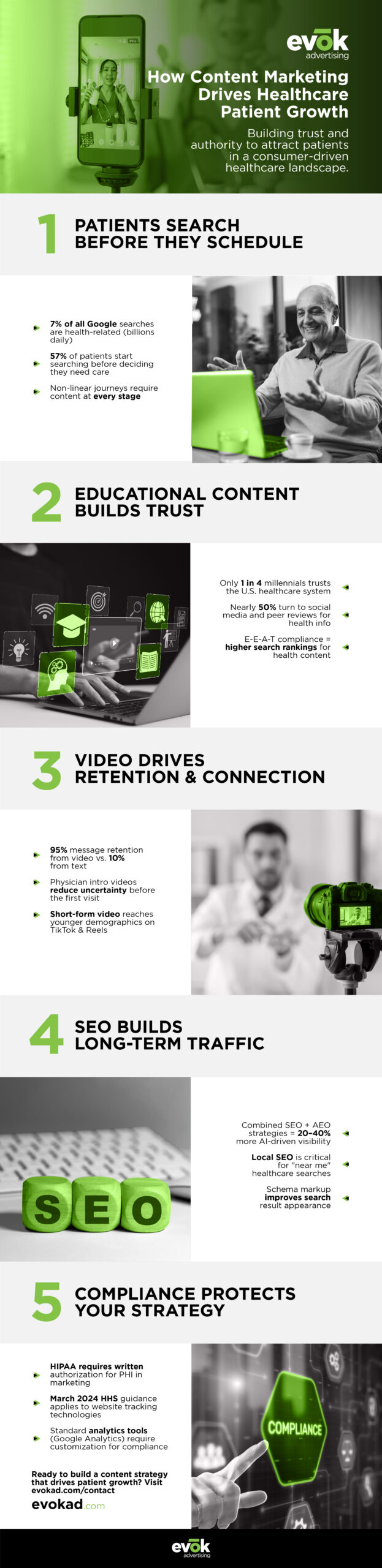
Why Content Marketing Is Essential for Healthcare Patient Acquisition

The days of building a patient base primarily through physician referrals are fading. While referral relationships remain valuable, healthcare organizations now find patients increasingly taking research into their own hands.
Today’s patients behave like consumers throughout their healthcare journey. They research symptoms on their phones, compare providers across multiple websites, read online reviews with scrutiny, and often book appointments through digital portals before their primary care physician even knows they’re seeking specialty care.
Health-Related Search Volume and Patient Behavior
According to Google research, approximately 7% of daily searches are health-related, representing billions of queries from people actively seeking healthcare information and providers. This consumer-driven behavior creates both a challenge and an opportunity for healthcare organizations.
Key Takeaway: Healthcare organizations that fail to participate during these critical research moments risk losing patients to competitors who do. Those who invest strategically in content marketing can capture attention, build trust, and guide prospective patients toward becoming long-term advocates.
The Trust Factor in Healthcare Marketing
Content marketing in healthcare serves a fundamentally different purpose than in most industries. While a retail brand might use content to drive immediate purchases, healthcare content must educate, reassure, and establish credibility before asking for any commitment. Patients aren’t buying a product; they’re entrusting their health to your organization. That requires a level of trust that only substantive, helpful content can build.
Healthcare Digital Content Market Growth

According to market research from Nova One Advisor, the healthcare digital content creation market reached $12.85 billion in 2025 and is projected to grow at an annual rate of over 22% through 2035. This growth reflects industry-wide recognition that content is no longer a nice-to-have but a core component of patient acquisition strategy.
Key Takeaway: Healthcare organizations that develop clearly defined, documented content approaches gain a significant advantage over competitors still treating content as an afterthought.
Patients don’t wake up one morning and decide to schedule an appointment. Their path to your organization unfolds across multiple stages, each with distinct information needs and content opportunities.
Awareness Stage
The patient journey typically begins with something feeling wrong—a symptom appears, or a routine screening reveals an issue. At this point, patients aren’t searching for providers; they’re searching for understanding. Queries like “why does my knee hurt when I climb stairs” dominate this phase. Content that addresses these early questions with clear, medically accurate information establishes your organization as a helpful resource before patients even realize they need your services.
Consideration Stage
The consideration stage follows as patients move from understanding symptoms to exploring treatment options. Search behavior shifts to queries like “treatment options for torn meniscus” or “is physical therapy or surgery better for rotator cuff injuries.” Educational content that explains conditions, compares treatment approaches, and sets realistic expectations performs well here. This is where trust solidifies—patients remember which sources provided genuinely helpful information.
Decision Stage
The decision stage is where patients actively seek providers. Searches become specific and local: “orthopedic surgeon near me” or “best-rated cardiologist in Orlando.” Content needs to shift toward physician profiles, patient testimonials, and clear explanations of what to expect. Research published in the Journal of Medical Internet Research confirms that online health information seeking directly influences healthcare decisions.
Non-Linear Patient Journeys and Emotional Considerations
The patient journey is rarely linear. Someone might jump from awareness directly to decision if symptoms are severe, or cycle back through consideration multiple times. Patient journey mapping research reveals that stress remains a consistent factor throughout the healthcare experience, often caused by inadequate information and uncertainty about next steps.
Key Takeaway: Content that acknowledges emotional realities and provides reassurance alongside clinical information resonates more deeply than purely factual content. A balanced content strategy ensures visibility and helpfulness at every stage.
Patient Healthcare Provider Research Behavior
84% of patients check online reviews before choosing new healthcare providers, according to Rater8’s December 2025 nationwide survey of over 1,000 U.S. patients. The research phase is extensive and multi-platform: 37% of patients review content across two different platforms, while 28% consult three or more platforms when evaluating providers (RepuGen, 2025 Patient Review Survey).
Primary Research Channels:
- Google reviews: 78%
- WebMD: 52%
- Facebook: 52%
- Healthgrades: 27%
Search Volume: 75% of people turn to the internet first when searching for health information in the U.S., with 75% of patients specifically searching online for doctors, dentists, medical care, and other healthcare providers. This translates to approximately 70,000 health-related searches per minute globally (2025 healthcare marketing research).
Review Depth: 51% of patients read at least six reviews before making a decision (Medical Economics, 2025), while 40% of patients have canceled appointments or avoided booking with providers specifically due to negative online feedback, even when friends and family recommended otherwise.
Critical Benchmark: Providers with 50+ reviews receive 10x more bookings than those with fewer than 10 reviews, and those with 100+ reviews see a 27-fold increase in patient bookings (Medical Economics, 2024).
Creating Educational Content That Builds Trust and Demonstrates Expertise

Trust is the currency of healthcare marketing, and educational content is how you earn it. Unlike industries where clever branding can drive decisions, healthcare requires patients to believe your organization possesses the knowledge, experience, and integrity to provide proper care.
Google’s E-E-A-T Framework for Healthcare Content
Google applies heightened scrutiny to healthcare content through its E-E-A-T framework: Experience, Expertise, Authoritativeness, and Trustworthiness. Healthcare falls under what Google classifies as YMYL content—”Your Money or Your Life”—a category where inaccurate information could cause real harm. This classification means healthcare content must meet higher quality standards to rank well.
How to Demonstrate E-E-A-T in Practice
Experience requires showing that your content comes from people who have actually practiced medicine. This doesn’t mean every post needs a physician byline, but content should reflect genuine clinical knowledge rather than surface-level information. Expertise manifests through depth and accuracy—current medical understanding, appropriate terminology, and collaboration between marketing teams and clinical staff.
Authoritativeness accumulates through consistent publication of high-quality content, recognition from trusted sources, and established credentials. Trustworthiness encompasses transparency about who you are and what motivates your content—clear disclosure of authorship, honest acknowledgment of limitations, and avoidance of exaggerated claims.
Healthcare Blog Strategy: Topics and Formats That Attract and Convert Patients

A healthcare blog without a strategy is just a collection of articles. With strategy, it becomes a patient-acquisition engine that drives qualified traffic, establishes expertise, and guides readers to schedule appointments.
Strategic Topic Selection
Topic selection should balance three considerations: what patients are searching for, what your organization wants to be known for, and where you can provide differentiated value. Keyword research reveals patient search behavior, organizational priorities determine which service lines deserve investment, and competitive analysis identifies content gaps you can fill.
High-Performing Healthcare Content Types
Condition explainer articles consistently perform well because they address fundamental patient questions early in their journey. Content explaining what a condition is, its causes, diagnosis, and treatment options serves patients at the awareness and consideration stages. Procedure and treatment guides serve patients further along, providing detailed information for decision-making. Physician profiles bridge the gap between educational content and conversion.
Content Length and Conversion Optimization
Long-form content generally performs better for complex medical topics, with comprehensive articles outperforming shorter pieces in search rankings for health-related queries. However, length alone doesn’t guarantee quality—content must be substantive throughout. Conversion optimization requires subtlety; heavy-handed calls to action interrupt the educational experience and undermine trust. Effective healthcare content seamlessly integrates conversion opportunities without pressuring those still in research mode.
Video Content for Healthcare: Engaging Patients Through Visual Storytelling

Video has become essential to healthcare marketing—not as a replacement for written content but as a powerful complement that reaches patients in ways text cannot. The format excels at humanizing healthcare organizations, explaining complex procedures visually, and building emotional connections that influence provider choice.
Video Marketing ROI in Healthcare Communications
According to current marketing research, 82% of marketers report positive return on investment from video marketing initiatives. This data point is particularly significant in healthcare settings, where effective patient communication directly influences clinical outcomes and patient satisfaction scores.
The retention advantage of video content creates both clinical and business value. When patients achieve genuine comprehension of their medical condition, available treatment pathways, and post-care protocols, they demonstrate improved decision-making capabilities and experience reduced anxiety throughout their care journey.
Key Takeaway: Video content’s documented marketing effectiveness translates to measurable improvements in patient education outcomes, making it a strategic communication tool for healthcare organizations focused on patient engagement.
Effective Healthcare Video Types
Physician introduction videos address uncertainty about who will be providing care. Seeing and hearing a physician speak about their approach creates a connection before the first appointment. Procedure explanation videos reduce fear by demystifying what patients can expect. Patient testimonial videos provide social proof that resonates more deeply than written reviews—though these require careful attention to compliance, including proper consent documentation.
Short-form video on platforms like TikTok, Instagram Reels, and YouTube Shorts has emerged as a significant opportunity for reaching younger demographics. Quick health tips, myth-busting content, and behind-the-scenes glimpses perform well in these formats.
How Does Video Content Impact Healthcare Patient Education and Engagement?
91% of businesses use video as a marketing tool, representing an all-time high for video adoption (Wyzowl, 2024 State of Video Marketing Survey of 967 marketing professionals and consumers). Healthcare organizations specifically report that video content delivers measurable improvements in both patient communication outcomes and marketing performance.
Patient Preferences and Engagement:
- 89% of consumers want to see more videos from brands in 2024 (Wyzowl, 2024)
- 91% of people have watched an explainer video to learn about a product or service
- 90% of video marketers report that video increases brand awareness
Conversion and Decision-Making Impact:
- 82% of people have been convinced to buy a product or service by watching a video (Wyzowl, 2024)
- Video content directly influences patient decisions about provider selection and treatment acceptance
- Explainer videos achieve particularly high engagement when educating audiences about complex medical topics
Short-Form Video ROI: 21% of marketers identify short-form video content as delivering the best return-on-investment among all content formats (HubSpot, 2025 State of Marketing Report surveying 1,400+ global marketing professionals). Short-form platforms (Instagram Reels, TikTok, YouTube Shorts) provide unprecedented reach to younger patient demographics who comprise healthcare’s future core audience.
Video Format Effectiveness:
- Physician introduction videos build trust before first appointments
- Procedure explanation videos reduce patient anxiety by clarifying expectations
- Patient testimonial videos provide authentic social proof that resonates more deeply than written reviews
Strategic Imperative: Video content’s documented effectiveness in building brand awareness (90%), meeting patient preferences (89% demand), and delivering superior ROI (21% identify as best-performing format) translates directly to measurable patient acquisition outcomes. Healthcare organizations investing in comprehensive video strategies—physician introductions, procedure explanations, and patient testimonials—gain competitive advantage in attracting and educating prospective patients who increasingly expect visual healthcare information.
SEO and Content Distribution Strategies for Maximum Healthcare Visibility

Creating excellent content accomplishes nothing if patients never discover it. Search engine optimization and strategic distribution ensure your educational resources reach the patients who need them.
Technical SEO Foundations
Traditional SEO begins with technical foundations that many organizations overlook: site speed, mobile responsiveness, secure connections, and clean site architecture. Keyword strategy requires understanding how patients actually search—patients search for “sharp pain in lower right abdomen” rather than “appendicitis symptoms.” Effective keyword research bridges clinical terminology with patient language.
Local SEO for Healthcare Organizations
Local SEO deserves particular attention because most patients seek care within their geographic area. Optimizing Google Business Profiles, maintaining consistent name, address, and phone information across directories, and generating authentic patient reviews all contribute to local search visibility.
AI-Powered Search and Generative Engine Optimization
The emergence of AI-powered search represents a significant shift in how patients find healthcare information. Google’s AI Overviews, ChatGPT, and other generative AI tools increasingly provide direct answers to health questions rather than simply linking to websites.
This shift requires healthcare marketers to consider Generative Engine Optimization (GEO) alongside traditional SEO. Content structured to provide clear, authoritative answers to specific questions is more likely to be cited by AI systems. According to research, brands investing in combined SEO and GEO strategies see a 20-40% increase in AI-driven visibility compared to those focusing solely on traditional SEO.
Key Takeaway: Healthcare organizations that optimize content for both traditional search engines and AI-powered platforms position themselves for visibility across all channels where patients seek information.
Compliance and HIPAA Considerations for Healthcare Content Marketing

Healthcare content marketing operates within regulatory boundaries that differ from other industries. Understanding these constraints and building compliant processes prevents costly mistakes while enabling effective marketing.
HIPAA Marketing Requirements
According to theU.S. Department of Health and Human Services, HIPAA requires written patient authorization before protected health information can be used for marketing purposes, with limited exceptions. Communications about treatment, case management, and care coordination are not considered marketing under HIPAA and don’t require authorization.
Patient Testimonials and Digital Tracking
Patient testimonials present particular compliance considerations. Using a patient’s image, story, or health information requires documented authorization that specifically covers the intended use. Digital tracking technologies have become a significant concern following updated HHS guidance in March 2024, which clarified that HIPAA applies to tracking technologies that collect or transmit protected health information.
Healthcare organizations have several options: implementing HIPAA-compliant analytics alternatives, configuring standard tools to prevent PHI collection, or accepting reduced analytics capability for strict compliance.
Building Your Healthcare Content Marketing Strategy for 2026

Healthcare organizations that thrive treat content marketing not as a tactical activity but as a strategic discipline integrated into their overall patient acquisition approach.
Strategic Planning and Resource Assessment
Strategic planning begins with understanding your specific patient acquisition needs. Which service lines need volume growth? What patient populations are you best positioned to serve? Resource assessment determines what’s realistic—effective content marketing requires sustained investment in planning, creation, optimization, and distribution. Many healthcare organizations find that partnerships with specialized agencies extend capacity while providing expertise that would take years to develop internally.
Keys to Content Marketing Success
Organizations that see the greatest returns share key characteristics: they maintain consistent publishing cadences over extended periods, balance educational content with strategic conversion optimization, invest in quality over quantity, and treat content marketing as a core competency that deserves ongoing investment.
Healthcare marketing has evolved dramatically, and content sits at the center of modern patient acquisition strategy. Organizations that invest in building genuine expertise, creating content that truly serves patient needs, and distributing effectively will continue to build trust and attract patients in an increasingly competitive landscape.
Provider Response to Reviews Impact on Patient Acquisition
45% of patients are more likely to choose providers who actively respond to patient reviews compared to those who do not (rater8, June 2025 survey of 1,024 U.S. adults). Active response engagement functions as an independent trust signal beyond rating scores.
Trust Impact:
- 41% of patients report increased trust when seeing provider responses to reviews (rater8, June 2025)
- Trust building occurs bidirectionally: from positive review appreciation and professional complaint handling
Review Generation Gap: 57% of patients rarely or never leave reviews for healthcare providers (rater8, June 2025), yet 74% indicated they are somewhat likely to leave a review when asked, representing significant untapped patient acquisition potential through systematic review solicitation.
Optimal Review Request Timing:
- 47% of patients are most likely to leave reviews within 24 hours of appointments (rater8, June 2025)
- Preferred communication channels: Email (46%), Text message (29%)
- Traditional methods (phone calls, in-person requests) show markedly lower response rates
Accelerating Patient Research Behavior: 73% of patients adopted new provider research behaviors or tools in the past 12 months, including AI chatbots, voice assistants, and social media platforms (rater8, June 2025). 26% of patients have been directly influenced by AI-generated review summaries (ChatGPT, Google AI Overviews) when choosing providers—placing AI influence nearly on par with traditional primary care physician referrals.
Strategic Imperative: Systematic reputation management with 24-hour email/text outreach windows represents measurable competitive advantage: 45% selection preference for engaged providers, 41% trust increase from responses, and 74% review willingness when asked create direct patient acquisition impact.
Frequently Asked Questions About Healthcare Content Marketing Strategy

How much should healthcare organizations invest in content marketing?
Investment levels vary based on organizational size, competitive landscape, and growth objectives. Industry benchmarks suggest that healthcare organizations typically allocate 2-10% of revenue to overall marketing, with content marketing accounting for a growing share. Rather than targeting a specific percentage, work backward from patient acquisition goals. Determine the number of new patients you need from organic channels, estimate the content investment required based on current performance data, and allocate resources accordingly. Organizations just starting content programs should expect a 6- to 12-month ramp-up period before seeing significant results.
How do you measure content marketing ROI in healthcare?
Measuring content marketing ROI requires connecting content engagement to downstream patient acquisition. Implement analytics that track user journeys from initial content interaction through appointment scheduling. Key metrics include organic traffic growth, engagement rates on educational content, conversion rates from content pages to appointment requests, and ultimately, the volume and value of patients acquired through content-driven channels. Combining marketing analytics with CRM and practice management data provides the complete picture needed for accurate ROI calculation.
What content formats are most effective for patient acquisition?
Different formats serve different purposes throughout the patient journey. Long-form educational articles capture search traffic from patients researching conditions and treatments. Video content builds emotional connection and visually explains complex procedures. Physician profiles and patient testimonials influence decision-making when comparing providers. The most effective strategies employ multiple formats strategically, using written content for comprehensive education, video for humanization, and conversion-focused content to capture patients ready to take action.
How often should healthcare organizations publish new content?
Consistency matters more than frequency. An organization that publishes two high-quality articles per month for three years will build more authority than one that publishes daily for three months then stops. For most healthcare organizations, 1 to 4 substantial pieces of content per month represents a sustainable pace. Quality should never be sacrificed for quantity; a comprehensive, well-researched article provides more value than several superficial pieces covering the same ground.
Can healthcare organizations use AI for content creation?
AI tools can assist healthcare content creation, but cannot replace human expertise and oversight. Useful applications include generating initial drafts for human refinement, conducting research, optimizing for search performance, and scaling production for routine topics. However, healthcare content must meet accuracy standards that current AI cannot guarantee without human verification. Clinical review of AI-generated healthcare content is essential before publication. The most effective approach treats AI as a productivity tool that augments human expertise rather than a replacement for clinical knowledge and editorial judgment.
Ready to build a content marketing strategy that drives measurable patient growth?
Our agency specializes in healthcare marketing that connects educational content to real patient acquisition results. From strategy development to content creation and performance measurement, our team brings deep healthcare expertise and a proven track record, working with organizations such as Broward Health and CAN Community Health.
Schedule a consultation to explore how a strategic content approach can strengthen your patient pipeline.