


Credit Union Marketing Agency Services: Which Strategies Drive the Best ROI?
Credit union CMOs face a familiar frustration: their marketing budgets are scrutinized more intensely than those of any other department. At the same time, leadership demands growth metrics that prove a return on investment. The pressure intensifies as fintech disruptors and megabanks pour resources into digital acquisition, making it harder for community-focused institutions to compete for attention. Yet the data tells a more optimistic story for credit unions willing to invest strategically and measure rigorously.
The question isn’t whether marketing drives member growth: it’s which strategies deliver the most substantial returns for your specific institution. A dollar spent on content marketing performs differently than a dollar spent on paid search, and both behave differently than investments in email automation or local SEO. Understanding these differences and building measurement systems capable of tracking them separates credit unions that achieve sustainable growth from those spinning their wheels with activities that feel productive but fail to move the needle.
This guide examines credit union marketing ROI through the lens of what actually works. We’ll break down the key metrics, compare channel performance with real industry benchmarks, and provide frameworks for calculating and tracking returns across your marketing mix. Whether you’re defending an existing budget, making the case for increased investment, or evaluating whether to partner with a credit union marketing agency, the strategies and data points here will help you make decisions grounded in evidence rather than intuition.
Understanding Credit Union Marketing ROI: Metrics That Actually Matter

Most credit union marketing teams track the wrong numbers. Website traffic, social media followers, and email open rates; these vanity metrics fill dashboards and quarterly reports, but reveal almost nothing about the actual business impact. For CMOs under pressure to justify marketing spend, this disconnect between activity metrics and financial outcomes creates a credibility gap that undermines budget conversations with leadership.
The fundamental challenge lies in how credit unions differ from typical consumer businesses. Members don’t make impulse decisions about financial relationships. The path from awareness to account opening often spans weeks or months, involves multiple touchpoints across digital and physical channels, and results in a relationship that could generate revenue for decades. Standard marketing ROI calculations built for e-commerce or retail simply don’t capture this complexity.
Credit union marketing ROI requires a different framework built around three core metrics: member acquisition cost (MAC), member lifetime value (MLV), and share of wallet growth. MAC calculates the total marketing investment required to acquire one new member, including advertising spend, content creation costs, technology platforms, and the time attributed to staff.
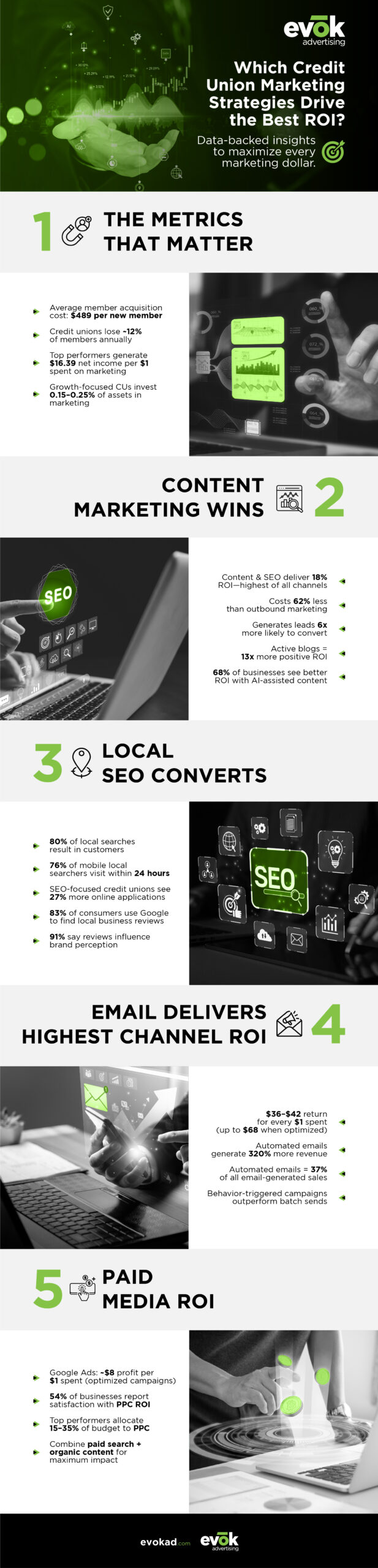
According to CUInsight research on credit union marketing budgets, the average acquisition cost per new member hovers around $489, though this figure varies significantly based on market competitiveness and acquisition methodology. MLV projects the total revenue a member generates across all products and services throughout their relationship with your institution. Share of wallet measures how much of a member’s financial activity flows through your credit union versus competitors.
The relationship between these metrics determines whether your marketing investment generates sustainable growth or simply burns through your budget. A credit union spending $350 to acquire members with a projected MLV of $2,800 operates in a fundamentally different position than one paying $600 per acquisition with the same lifetime value. Both might report identical membership growth numbers, but one builds equity while the other erodes margins. According to FlexCUTech’s analysis of member acquisition costs, the average credit union closes 12% of its account base each year, meaning institutions must replace their entire member base roughly every eight years just to stay even—not to grow.
Research from The Financial Brand, analyzing 227 credit unions, found that marketing budgets average 0.12% of assets, with successful growth-focused institutions often investing between 0.15% and 0.22% of assets. However, budget size alone predicts little about outcomes. In the same study, credit unions generated an average of $16.39 in net income for every dollar spent on marketing in 2018, up from $12.22 in 2015. The institutions generating the most substantial returns share a common characteristic: they’ve built measurement systems that connect marketing activities to member behavior at the product level, not just at acquisition.
This granular tracking reveals which channels, campaigns, and messages drive not just new members, but new members who open checking accounts, apply for auto loans, or consolidate their banking relationships. The difference matters enormously. A member who joins for a single certificate of deposit generates a fraction of the lifetime value of one who establishes your credit union as their primary financial institution. Effective ROI measurement distinguishes between these outcomes and attributes them back to specific marketing investments.
Why Content Marketing Delivers the Highest ROI for Credit Unions

When Databox surveyed marketing leaders across financial services about channel performance, content marketing and SEO emerged with the highest ROI at 18%, outperforming email (16%), organic social (14%), and paid search and social (13% each). For credit unions specifically, these numbers likely understate content’s advantage because they don’t capture the compounding returns that educational content generates over time.
The mechanics behind content marketing’s ROI advantage stem from how consumers make financial decisions. Unlike impulse purchases, choosing a credit union involves research, comparison, and trust-building that unfold across multiple sessions. A prospective member searching for “how to improve my credit score” or “first-time homebuyer mistakes to avoid” isn’t ready to open an account today. But the credit union that answers their question thoroughly and without a hard sell earns consideration when they are ready. Content creates that initial touchpoint at a fraction of the cost of paid advertising, and the asset continues working indefinitely without additional spend.
Financial literacy content performs exceptionally well for credit unions because it aligns marketing objectives with member service. According to Semrush’s content marketing research, 58% of B2B marketers reported an increase in sales and revenue due to content marketing. Additionally, content marketing costs 62% less than outbound marketing and generates leads six times more likely to convert. When your content genuinely helps someone understand compound interest, navigate mortgage options, or build an emergency fund, you’re demonstrating the member-first philosophy that differentiates credit unions from traditional banks. This isn’t just brand positioning—it’s functional proof of your values delivered before someone becomes a member.
The content types generating the strongest returns for credit unions typically fall into three categories. Educational guides addressing major financial decisions (buying a home, financing a vehicle, planning for retirement) attract high-intent searchers actively moving toward products you offer. Comparison content that helps readers evaluate options (e.g., credit union vs. bank, fixed vs. variable rates) captures prospects in decision mode. Local financial content addressing regional economic conditions, housing markets, or community resources builds relevance with your specific service area while facing less competition than national topics.
Production costs for content marketing have decreased substantially with the advancement of AI-assisted writing tools. According to DemandSage’s analysis, 68% of businesses report receiving better content marketing ROI by adopting AI for research, outlining, and draft generation. However, quality control and strategic direction still require human expertise. A well-structured content marketing program for a credit union can produce two to four substantive articles per month for a fraction of the cost of equivalent paid media. More importantly, that content accumulates. An article published today continues generating traffic and leads for years, while a paid ad stops working the moment you stop paying.
The compounding effect of content marketing creates a widening gap between credit unions that consistently invest in content marketing and those that don’t. Research from Firework found that businesses maintaining active blogs see 13 times more positive ROI than those without consistent content programs. For credit unions competing against institutions with larger advertising budgets, content marketing offers a path to visibility that doesn’t require outspending competitors—it requires out-helping them.
SEO and Local Search: The Most Cost-Effective Member Acquisition Channel

Credit unions exist to serve specific communities, and local search optimization aligns perfectly with that mission. When someone searches “credit union near me” or “best auto loan rates in [city],” they’re expressing high purchase intent within your geographic footprint. Capturing these searches costs nothing per click and delivers prospects already predisposed to local financial relationships.
The data supporting local SEO investment is compelling. According to BrightLocal’s 2025 research, 80% of US consumers search online for local businesses weekly, with 32% searching daily. SEO.com reports that 80% of local searches result in customers, while data from Krofile indicates that 76% of people who conduct local searches on smartphones visit a business within 24 hours. For credit unions, these statistics translate directly into branch visits, account applications, and loan inquiries.
The ROI advantage of SEO over paid channels becomes clear when you examine the numbers. For competitive financial keywords, costs run significantly higher. SEO requires an upfront investment in content and technical optimization; however, once rankings are established, ongoing costs decrease significantly while traffic continues to increase.
Local SEO for credit unions centers on several core elements. Google Business Profile optimization ensures your branches appear in map results and local packs when members search for nearby financial services. Google Search and Google Maps are the most frequently used tools for local searches, with over half of consumers utilizing these platforms to find local business information. Complete profiles with accurate hours, services, photos, and regular posts significantly improve visibility.
Location-specific landing pages targeting each branch’s service area capture searches like “credit union in Heathrow, FL” or “car loans in Winter Park, FL.” These pages should include localized content addressing community-specific financial needs, local economic conditions, and branch-specific information. Research from a National Credit Union Administration study found that credit unions investing in SEO saw an average 27% increase in online membership applications compared to those that didn’t prioritize search optimization.
Review management also plays a critical role in local search performance. BrightLocal’s Consumer Review Survey found that 83% of consumers use Google to find local business reviews, with 91% stating that reviews significantly influence their overall perception of a brand. Credit unions should actively solicit reviews from satisfied members and respond thoughtfully to all feedback—both positive and negative. This engagement signals to search engines that your institution is active and responsive while building the social proof that influences member decisions.
Comparing Paid Advertising ROI Across Different Marketing Channels
While organic strategies deliver superior long-term ROI, paid advertising remains essential for credit unions pursuing aggressive growth or launching new products. The key lies in understanding which paid channels deliver results specifically for financial services, and how to optimize spend for member acquisition rather than vanity metrics.
Google Ads represents the most direct path to high-intent prospects. When someone searches “best credit union savings rates” or “auto loan pre-approval,” they’re actively shopping for financial products. DemandSage’s analysis of Google Ads performance reports that businesses average $2 in revenue for every $1 spent, though financial services campaigns often exceed this benchmark due to higher customer lifetime values. According to Google Ads ROI statistics, businesses generate approximately $8 in profit for every $1 spent on Google Ads when campaigns are appropriately optimized.
The challenge for credit unions lies in cost per click. Financial keywords rank among the most expensive in Google’s auction system. Legal services keywords average over $130 per lead, and while credit union keywords cost less, they still require careful budget management. The key is focusing on high-intent, conversion-oriented keywords rather than broad awareness terms.
Social media advertising offers more affordable reach but typically lower intent. Facebook and Instagram excel at targeting specific demographics—young professionals for first-time homebuyer programs, families for auto loans, or retirees for certificate products. HubSpot’s State of Marketing Report found that for B2C brands, email marketing and paid social content delivered the strongest ROI. Credit unions can leverage these platforms for awareness campaigns and retargeting previous website visitors; however, conversion rates typically lag behind those of search advertising.
According to WebFX survey data, 54% of businesses report satisfaction with their PPC ROI despite rising costs, and 26% plan to increase spending in the next six months. The key finding: Satisfied advertisers typically allocate 15-35% of their total marketing budget to PPC—enough for a meaningful impact without overdependence on paid channels.
The most effective credit union advertising strategies combine paid and organic efforts to achieve maximum impact. Use paid search to capture high-intent queries for specific products (mortgages, auto loans, checking accounts) while building organic visibility for educational content that nurtures longer-term prospects. Retarget website visitors with social ads to stay top-of-mind during extended consideration cycles. This integrated approach maximizes the strengths of each channel while mitigating its individual weaknesses.
How to Calculate and Track Marketing ROI for Credit Unions

Accurate ROI calculation separates high-performing credit union marketing agencies from those that continually struggle to justify their budget. The challenge isn’t mathematical—it’s establishing tracking systems that connect marketing activities to downstream member behavior across extended timeframes.
The basic ROI formula remains straightforward: (Revenue Generated – Marketing Cost) / Marketing Cost × 100. For a campaign spending $10,000 that generates $50,000 in new loan volume, the calculation yields 400% ROI. However, this simplicity masks a significant level of complexity in financial services marketing. How do you attribute that loan to marketing when the member first visited your website six months ago, received three emails, saw a social ad, and finally walked into a branch? How do you account for members who join for one product but later add others?
Member acquisition cost provides a more precise starting point. Total all marketing expenses for a defined period—advertising spend, content creation, technology platforms, agency fees, and attributed staff time. Divide by the number of new members acquired during that period. CUInsight’s research indicates that the industry average is around $489 per new member, although this varies substantially depending on the methodology and market competitiveness. Track this number on a monthly or quarterly basis to identify trends and assess the effectiveness of your campaign.
Calculating a member’s lifetime value requires historical data on average relationship length, products per member, and revenue per product. The most straightforward approach is to multiply the average annual revenue per member by the average membership tenure. More sophisticated models incorporate product adoption curves, cross-sell rates, and retention probability by segment.
Successful credit unions use this data to determine appropriate acquisition investment levels—spending more to acquire members with higher projected lifetime values.
Campaign-level ROI tracking requires proper attribution infrastructure. Implement UTM parameters on all digital campaigns to track which channels and messages drive website visits. Use dedicated landing pages or phone numbers for specific campaigns to isolate performance. Connect your CRM or core banking system to marketing platforms where possible, enabling closed-loop reporting that shows which marketing touchpoints preceded account openings and loan applications.
The Financial Brand’s research on marketing metrics highlights the industry’s shift toward more sophisticated measurement. Traditional KPIs, such as click-through rates, remain essential, but leading institutions now prioritize customer lifetime value, engagement quality, and multi-touch attribution. Financial marketers increasingly recognize that first-click and last-click attribution models oversimplify the member journey. Multi-touch attribution distributes credit across all touchpoints, providing a more accurate picture of marketing impact.
Email Marketing and Marketing Automation: Scaling Efficiency and Returns

Email consistently delivers the highest ROI of any digital marketing channel, and credit unions possess a significant advantage: existing member relationships that provide both permission and context for personalized communication. The challenge lies in moving beyond batch-and-blast newsletters toward automated, behavior-triggered campaigns that scale personalization.
The ROI data speaks for itself. According to research cited by multiple industry sources, email marketing generates an average return of $36-$ 42 for every dollar spent—a 3,600-4,200% ROI that surpasses other channels. Omnisend’s analysis found that US merchants see returns as high as $68 per dollar spent when campaigns are correctly optimized. For credit unions, these returns compound because email nurtures existing member relationships toward additional products, not just new member acquisition.
The gap between average and exceptional email performance comes down to automation. OptinMonster’s email statistics report that automated emails generate 320% more revenue than non-automated campaigns. Automated welcome sequences for new members, triggered cross-sell campaigns based on account behavior, and re-engagement flows for dormant relationships all outperform manual campaigns by substantial margins. In 2024, automated emails accounted for 37% of all email-generated sales, according to Omnisend’s research.
Segmentation drives relevance, and relevance drives response. Credit unions sitting on rich member data—account types, transaction patterns, life stage indicators, product holdings—can personalize communications far beyond what competitors achieve with purchased lists. A member who recently paid off an auto loan becomes a prime candidate for a vehicle replacement campaign. A member maintaining high checking balances might respond to certificate or investment messaging. Parents of teenagers approaching driving age receive auto loan information at precisely the right moment.
Email also plays a critical role in the consideration cycle for major financial products. Members don’t decide on mortgages or auto loans impulsively. They research, compare, and deliberate over weeks or months. Nurture sequences that provide genuinely helpful information during this period—without aggressive selling—position your credit union as a trusted advisor. When they’re ready to apply, you’re at the top of their mind.
The compliance considerations unique to financial services require careful attention to email content. Regulatory disclosures, rate accuracy, and fair lending requirements all apply to marketing communications. Building compliant templates and review processes into your automation workflow prevents costly mistakes while maintaining the efficiency gains automation provides.
Multi-Channel Attribution: Measuring the Complete Member Journey

The member journey from awareness to account opening rarely follows a straight line. A prospective member might discover your credit union through a Google search, read several blog posts over subsequent weeks, click a retargeting ad, receive an email after downloading a guide, and finally call a branch to open an account. Which marketing investment gets credit for that acquisition?
Attribution modeling attempts to answer this question, and the approach you choose significantly impacts how you evaluate channel performance and allocate budget. First-touch attribution credits the initial interaction—in our example, the organic search- that leads to a conversion. Last-touch attribution credits the final interaction before conversion—the branch call. Neither captures the whole picture.
Multi-touch attribution distributes credit across all touchpoints based on various weighting schemes. Linear attribution divides credit equally among all interactions. Time-decay attribution weights recent touchpoints more heavily. Position-based models emphasize first and last touch while still crediting middle interactions. Financial marketers are increasingly adopting these sophisticated models to accurately assess how various interactions contribute to member acquisition.
The practical challenge lies in connecting data across systems. Your website analytics tracks digital behavior. Your email platform records opens and clicks. Your core banking system logs account openings. Your call tracking captures phone inquiries. Building a unified view requires either integrated marketing platforms or manual data compilation—neither is trivial for resource-constrained credit union marketing teams.
Start with what’s measurable before pursuing perfection. Implement consistent UTM tagging across all digital campaigns. Use unique phone numbers for major campaigns to track call-driven conversions. Survey new members about how they heard about your credit union. This qualitative data complements digital tracking and captures offline influences that analytics often overlook.
Member engagement metrics provide valuable insight even when direct conversion attribution proves difficult. Tracking logins, transactions, utilization rates, and digital engagement offers a more comprehensive view of relationship health than projected lifetime value alone. These indicators help predict which members are at risk of leaving and which are likely to be interested in additional products and services.
The goal isn’t perfect attribution—it’s attribution good enough to inform resource allocation decisions. Suppose your data consistently shows that members who engage with educational content convert at higher rates than those acquired through direct-response advertising. In that case, that insight should influence your budget, even if there is no precise dollar-for-dollar measurement.
Partnering with a Credit Union Marketing Agency for Maximum ROI

The strategies outlined in this guide require specialized expertise, consistent execution, and ongoing optimization. Many credit unions lack the internal resources to implement comprehensive multi-channel marketing programs while simultaneously managing measurement systems sophisticated enough to demonstrate ROI. This reality drives the decision to partner with agencies specializing in credit union marketing.
A credit union marketing agency brings specialized expertise in financial services marketing, including regulatory compliance requirements, industry benchmarks, and proven tactical approaches. Rather than building these capabilities internally through trial and error, credit unions access institutional knowledge refined across multiple client engagements. The learning curve shortens dramatically when your partner has already solved the problems you’re encountering.
The right agency partnership also provides scalability that internal teams struggle to match. Campaign volume can flex with business needs—ramping up for product launches or growth initiatives, scaling back during budget constraints—without the fixed costs of permanent headcount. Access to specialized skills in areas like marketing automation, paid media optimization, or analytics implementation doesn’t require hiring for each capability individually.
At evok advertising, we’ve partnered with credit unions, including FAIRWINDS Credit Union,Florida Credit Union,Space Coast Credit Union, and iTHINK Financial, to develop data-driven marketing strategies that deliver measurable results in member acquisition and retention. Our credit union marketing services combine deep industry knowledge with cross-channel execution capabilities—from SEO and content marketing to paid media and marketing automation.
The investment in specialized agency support typically pays for itself through improved campaign performance, reduced waste from ineffective tactics, and freed internal capacity for strategic initiatives rather than tactical execution. For credit unions serious about competing for member attention in an increasingly digital marketplace, the question isn’t whether to seek expertise—it’s how to structure partnerships that align agency incentives with member growth outcomes.
Frequently Asked Questions

What is a good marketing ROI for credit unions?
Credit unions should target a marketing ROI of at least 5:1, meaning $5 in new revenue for every $1 spent on marketing. High-performing institutions achieve ratios of 10:1 or higher, particularly for established programs with compounding content assets. According to The Financial Brand’s research, credit unions generated an average of $16.39 in net income for every dollar spent on marketing. However, this figure includes all marketing activities rather than isolating specific campaigns.
How much should credit unions spend on marketing?
Industry benchmarks suggest that credit unions should invest 0.10% to 0.15% of their assets in marketing for maintenance-level visibility, with growth-focused institutions investing 0.15% to 0.25% of their assets. According to CUInsight research, growth-focused credit unions are pushing budgets as high as 0.20-0.25% of assets to remain competitive in high-cost media markets. The appropriate budget depends on growth objectives, market competitiveness, and current brand awareness levels.
Which marketing channel delivers the best ROI for credit unions?
Content marketing and SEO consistently deliver the highest long-term ROI for credit unions, with industry data showing 18% ROI compared to 13% for paid channels. Email marketing also performs exceptionally well, generating $36 to $ 42 for every dollar spent, according to multiple industry studies. The optimal approach combines organic strategies for sustainable visibility with targeted paid campaigns for specific product promotions or growth initiatives.
How long does it take to see ROI from credit union marketing?
Paid advertising generates measurable results within weeks, while content marketing and SEO typically require 6-12 months to show significant returns. According to First Page Sage’s research, SEO campaigns in the financial services sector achieve a positive ROI with a break-even point of approximately 7 months. The advantage of organic strategies is their compounding nature—returns continue growing even after active investment slows, while paid channels stop performing immediately when spending stops.
How do credit unions measure member lifetime value?
Member lifetime value (MLV) is calculated by multiplying the average annual revenue per member by the average membership tenure, then subtracting acquisition and servicing costs. More sophisticated models incorporate product adoption curves, cross-sell probability, and retention rates by segment. Credit unions should calculate MLV by member segment to identify which acquisition sources deliver the highest-value relationships, informing both channel investment and targeting strategies.
Ready to optimize your credit union’s marketing ROI? Contact us to discuss how our credit union marketing expertise can help you attract more me